Intel has spent most of this decade trying to break into data center AI, and its track record reads like a list of codenames that never reached a shelf.
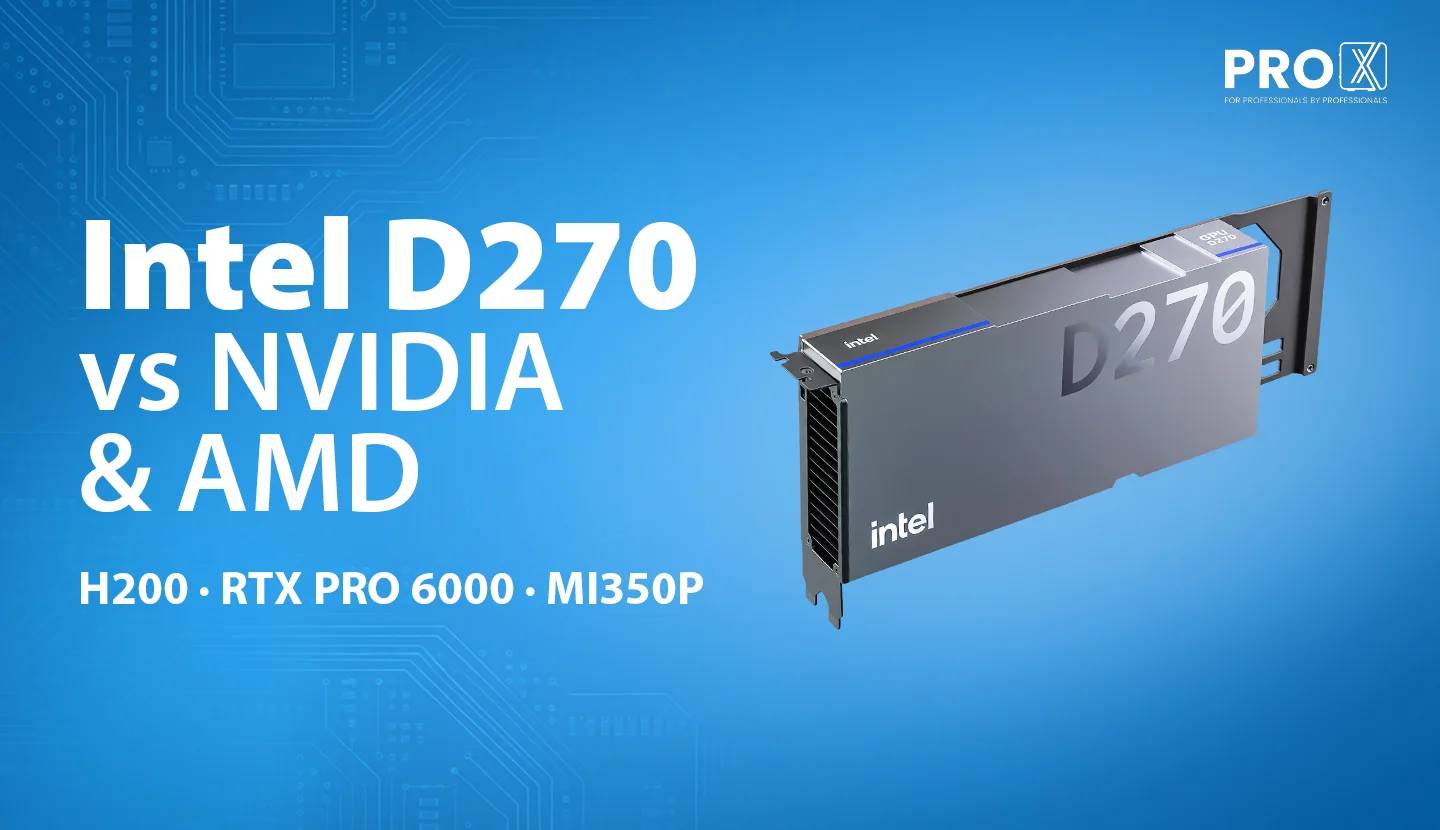
Intel has spent most of this decade trying to break into data center AI, and its track record reads like a list of codenames that never reached a shelf. The GPU D-Series, called Crescent Island until this month, is a smaller and more focused attempt. Its first card, the D270, does one job: running AI models that are already trained, a task called inference, inside the ordinary air-cooled servers most companies already own.
The headline number is memory. Intel’s own D270 carries 160GB, and partner-built versions go up to 480GB on a single PCIe card. For reference, the NVIDIA H200 we put through multi-user LLM testing earlier this year has 141GB.
A number like that pulls attention. Whether it pulls purchase orders depends on three things: what the card gives up to get there, how it stacks against AMD and NVIDIA, and how much work it takes to get your current AI software running on it. Below is each, spec by spec.
The Intel GPU D-Series is a family of data center cards built only for AI inference, and the D270 is its first model. Intel announced the name and the final performance figures at the OCP Global Summit on October 12, 2026, a year after it first showed the chip under the Crescent Island codename.
The D270 runs on Xe3P, an AI-tuned version of the same Xe architecture inside Intel’s Panther Lake laptop chips. The odd detail is that this GPU can barely do graphics. Intel removed the ray tracing and 3D graphics hardware and spent that space on 256 XMX engines, the blocks that handle matrix multiplication, which is the math underneath every AI model.
As of now, customer samples are shipping, Dell, HPE, Lenovo and Supermicro are named as system partners, and broader availability is planned for 2027. Intel has not announced a price.
The D270 pairs moderate compute with a very large, slower memory pool: 1.3 PFLOPS of FP8 compute, 1.5 TB/s of memory bandwidth and up to 480GB of memory, all inside 350W.
| Spec | Intel GPU D270 |
|---|---|
| Architecture | Xe3P (Crescent Island) |
| Xe cores | 32 |
| XMX matrix engines | 256 |
| GPU clock | About 2.5 GHz |
| Peak FP8 compute | 1.3 PFLOPS |
| Peak FP64 vector compute | 10.2 TFLOPS |
| Memory | 160GB LPDDR5X on Intel’s card, up to 480GB on partner cards |
| Memory bus | 1280-bit with ECC |
| Memory bandwidth | 1.5 TB/s |
| L2 cache | 32MB |
| Host interface | PCIe 5.0 x16 |
| Board power | 350W |
| Cooling | Passive air, dual-slot PCIe card |
| Media engine | Video encode and decode |
| Status | Customer sampling, broad availability in 2027 |
FP8 is an 8-bit number format that lets a model run faster and in half the memory of the standard 16-bit format, with a small hit to output quality. Most production inference now runs at FP8 or lower, so 1.3 PFLOPS (1.3 quadrillion operations per second) is the figure to watch on this card.
The memory is the bold choice. Every major AI accelerator from NVIDIA and AMD uses HBM (high bandwidth memory), stacks of memory chips bonded right beside the processor, which is fast, expensive and in short supply. Intel went with LPDDR5X, the same family of memory inside flagship phones and thin laptops, and spread 20 chips across a 1280-bit bus to win back bandwidth. It is the call a storage buyer makes between NVMe and hard drives: one moves data faster, the other holds far more per rupee, and the right pick depends on whether your bottleneck is speed or space.
The 350W rating covers the whole card, memory included, which puts it at or below the server CPU it will sit next to. Eight D270s draw about 2.8kW, a load a regular air-cooled rack handles without new plumbing.
One line deserves a second read: the 480GB figure belongs to partner-built cards. Intel’s own card ships with 160GB, and Intel’s claim of running a 300-billion-parameter model on one card leans on those bigger versions, the kind of footnote that tends to surface after the purchase order is signed.
Against the PCIe AI cards you can buy today, the D270 leads on memory per card and per watt, roughly matches the RTX PRO 6000 on bandwidth, and trails AMD’s MI350P and NVIDIA’s H200 on raw speed.
| Spec | Intel GPU D270 | AMD Instinct MI350P | NVIDIA RTX PRO 6000 Blackwell Server | NVIDIA H200 NVL |
|---|---|---|---|---|
| Architecture | Xe3P | CDNA 4 | Blackwell | Hopper |
| Memory | 160GB LPDDR5X (480GB partner) | 144GB HBM3E | 96GB GDDR7 | 141GB HBM3e |
| Memory bandwidth | 1.5 TB/s | 4.0 TB/s | 1.6 TB/s | 4.8 TB/s |
| Peak FP8, dense | 1.3 PFLOPS | 2.3 PFLOPS | About 1 PFLOPS (2 with sparsity) | About 1.7 PFLOPS |
| Board power | 350W | 450 to 600W | 400 to 600W | Up to 600W |
| Memory per watt at max power | 0.46 GB/W (1.37 on 480GB cards) | 0.24 GB/W | 0.16 GB/W | 0.24 GB/W |
| Cooling | Passive air | Passive air | Passive air | Passive air |
| Software stack | oneAPI, PyTorch XPU, vLLM, SGLang | ROCm | CUDA | CUDA |
| Status | Sampling, 2027 availability | Shipping | Shipping | Shipping |
Treat the FP8 row as a ceiling. Independent testing of the MI350P measured roughly two thirds of its rated FP8 figure on real matrix workloads, and every card here loses a similar slice once actual model shapes and power limits come into play.
Memory bandwidth sets how fast each user sees words appear, because the card reads the model’s weights from memory for every token it generates (a token is a word or a piece of one). On that measure the D270 sits beside the RTX PRO 6000 and well behind the two HBM cards; the H200 reads its memory about three times faster.
Memory capacity sets how big a model you can load and how many conversations you can keep open. Here no current PCIe card comes close: a 480GB partner D270 holds five times the RTX PRO 6000’s memory at a little over half its power. On compute per watt, the D270 and MI350P are nearly tied at about 3.7 to 3.8 TFLOPS per watt; AMD simply runs a bigger, hungrier chip.
Our own testing shows why capacity matters. In our H200 multi-user benchmarks, the H200 served 2,000 users on an 8B model, yet the recommended user count fell to 64 on 120B-class models because the KV cache (the memory each active conversation uses to hold its context) filled the card. More memory per card lifts that ceiling. The trade is that each of those users will see text arrive slower than on an H200.
The 2027 flagships from AMD and NVIDIA are built for liquid-cooled racks, which leaves the D270 mostly alone in the high-capacity, low-power PCIe lane for the next year.
NVIDIA. In September 2025, NVIDIA announced Rubin CPX, a 128GB GDDR7 chip built for prefill, the stage where a model reads and processes the whole prompt before it starts writing an answer. CPX dropped off NVIDIA’s roadmap at GTC in March 2026, after NVIDIA licensed Groq’s inference technology and launched Groq 3 LPX racks in its place. Supply-chain analyst Ming-Chi Kuo now reports CPX is back with 168GB of HBM4, a 2,300W power budget and its own racks, with production from Q1 2027. So the cheaper-memory idea NVIDIA shelved is the one Intel built the D270 around, and NVIDIA’s revived version reportedly walks away from cheap memory entirely. For air-cooled servers, the RTX PRO 6000 stays NVIDIA’s main AI card.
AMD. The MI455X ships inside AMD’s Helios racks from Q3 2026, and the MI500 series follows in 2027 on a 2nm process with HBM4E memory. Both are rack-scale parts. The MI350P remains AMD’s PCIe option, and AMD has not announced its successor.
Intel. Intel’s roadmap now splits in two. The D-Series covers inference in standard servers, while Jaguar Shores, an HBM-based rack-scale design, is meant for training. Intel has also confirmed a follow-up GPU architecture after Xe3P, called Xe Next.
For an Indian business running a regular server room, that split matters. Liquid cooling is out of reach for many offices here, so the cards that drop into an existing rack in 2027 will most likely be the D270, the MI350P and the RTX PRO 6000, unless AMD or NVIDIA announce a new PCIe part.
The D270 suits work that runs out of memory before it runs out of speed: mixture-of-experts models, many users or agents at once, and long documents.
If you’re running a 4x RTX 5090 server today, the comparison gets interesting. In our H200 vs 4x RTX 5090 multi-user test, gemma-4-31B sat close to each card’s 32GB limit, and at 1,024 users per-user speed fell to 4.49 tokens per second with a median wait of 150 seconds. At FP8 that model takes roughly 31GB, so a single 160GB D270 holds it with well over 100GB left for conversations. The 5090 box still has more total bandwidth across its four cards, so for small models with many users it may stay faster per rupee. Price will decide that one.
Expect some setup work. The core open-source stack (Linux driver, PyTorch, vLLM, SGLang) already supports Intel GPUs, while anything built on NVIDIA’s CUDA has to be swapped out or ported.
| What you run today | Effort on the D270 | What changes |
|---|---|---|
| Models served through vLLM or SGLang | Low | Use Intel’s prebuilt containers or the upstream Intel GPU build |
| Your own PyTorch inference scripts | Low to medium | Change the device from “cuda” to “xpu” |
| TensorRT-LLM, NVIDIA NIM, repos with hand-written CUDA kernels | High | Port the code or switch to an open serving engine |
| Brand-new open models | Medium | Support usually lands after the CUDA version |
| Windows-based servers | High | Plan the deployment on Linux |
Drivers. Intel’s open-source Xe driver has carried Crescent Island code since Linux 6.19, and later kernels added power reporting and IDs for several D-Series variants. That first patch was a single device ID, merged roughly a year before any samples existed. Intel’s compute runtime, graphics compiler and media driver all list the chip now, which is a healthier starting point than Intel’s earlier accelerators had.
PyTorch. PyTorch has a built-in “xpu” device, its name for Intel GPUs. In clean code, moving from NVIDIA means changing .to(“cuda”) to .to(“xpu”). In a repo where “cuda” is hardcoded across thirty files, budget an afternoon.
vLLM and SGLang. Mainline vLLM supports Intel GPUs through an XPU kernel package that installs on its own. Intel also ships llm-scaler, Docker containers with vLLM, PyTorch, oneAPI and drivers already matched. Today those containers target Intel’s Arc Pro workstation cards, which share the Xe foundation with the D270. The newest release runs vLLM 0.26 while mainline vLLM is on 0.31, so new models reach Intel a step later.
Multiple cards. Intel lists PCIe 5.0 as the D270’s only connection, with no NVLink-style bridge announced. Splitting one model across several cards runs over PCIe through Intel’s oneCCL library, which adds communication overhead as you add cards.
Switching to the D270 is a lot like moving an office from one printer brand to another. The documents print fine once the new drivers are in, and then someone finds the one macro written in 2019 that only worked with the old printer. Audit your serving stack for CUDA-only pieces while you plan the move, well before the cards arrive.
For most buyers, the D270 is a 2027 planning item today: there is no price, no independent benchmark data, and volume shipping is still a year out. LPDDR5X prices have also been climbing, which could widen the gap between the 160GB and 480GB cards once pricing lands.
ProX PC is an AI hardware solution provider in India, building systems for teams that want to run AI on their own premises. Whether you’re deciding between today’s GPUs and waiting for the D-Series, or your requirement doesn’t fit a standard spec sheet, our professionals can help you work it out.
Want the D270 early? As soon as broader availability opens in India, ProX PC will be among the first to offer D-Series systems. Register your interest with us and we’ll reach out the moment we can take orders.
If you’re facing any hardware problem, big or small, reach out and our team will get back to you.
Intel’s own D270 card has 160GB of LPDDR5X memory, and partner-built cards can carry up to 480GB. Both versions run at 1.5 TB/s of memory bandwidth.
Customer samples are shipping now, and Intel plans broader availability in 2027. Intel has not announced pricing.
CUDA is NVIDIA’s own platform and runs only on NVIDIA GPUs. The D270 runs on Intel’s oneAPI stack and works with PyTorch, vLLM and SGLang, so CUDA-specific code needs porting.
The H200 has about three times the memory bandwidth and more FP8 compute, so each user gets faster responses on it. The D270 holds more memory (160 to 480GB against 141GB) at 350W, so it can host larger models or more conversations per card.
Intel designed the D270 for inference. Its plans for training-focused hardware sit with Jaguar Shores, a separate HBM-based design.
Resources you may find helpful.

Harness the power of GPU servers to revolutionize business operations with unparalleled performance in AI, data analysis, and rendering tasks.
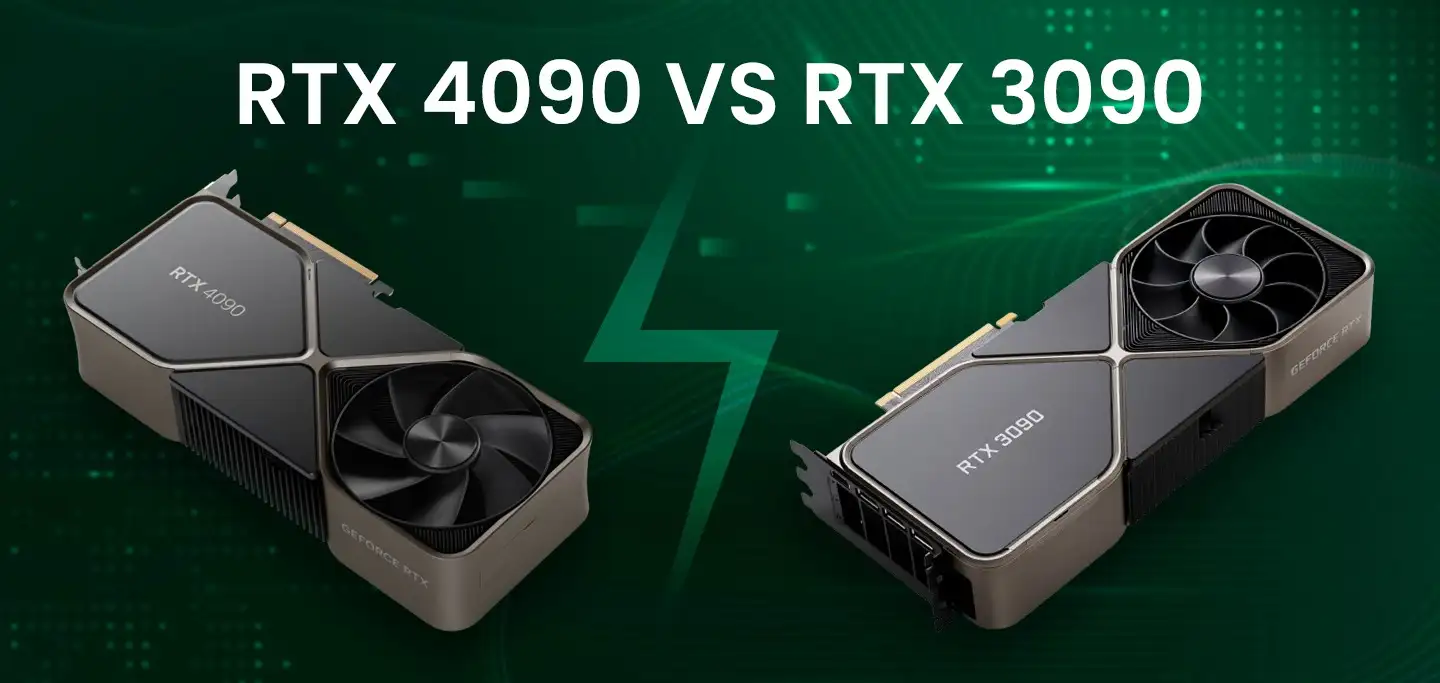
The power of NVIDIA® GeForce RTX 4090: Redefining deep learning benchmarks, exceeding expectations set by the RTX 3090
Best GPUs for AI and deep learning in 2024: NVIDIA's RTX 4090, A6000, A100, and more, benchmarked for performance and efficiency

Keep your computer running smoothly with these 10 essential tips. From regular backups to cleaning dust and updating software, ensure optimal performance and longevity.