The power of NVIDIA® GeForce RTX 4090: Redefining deep learning benchmarks, exceeding expectations set by the RTX 3090
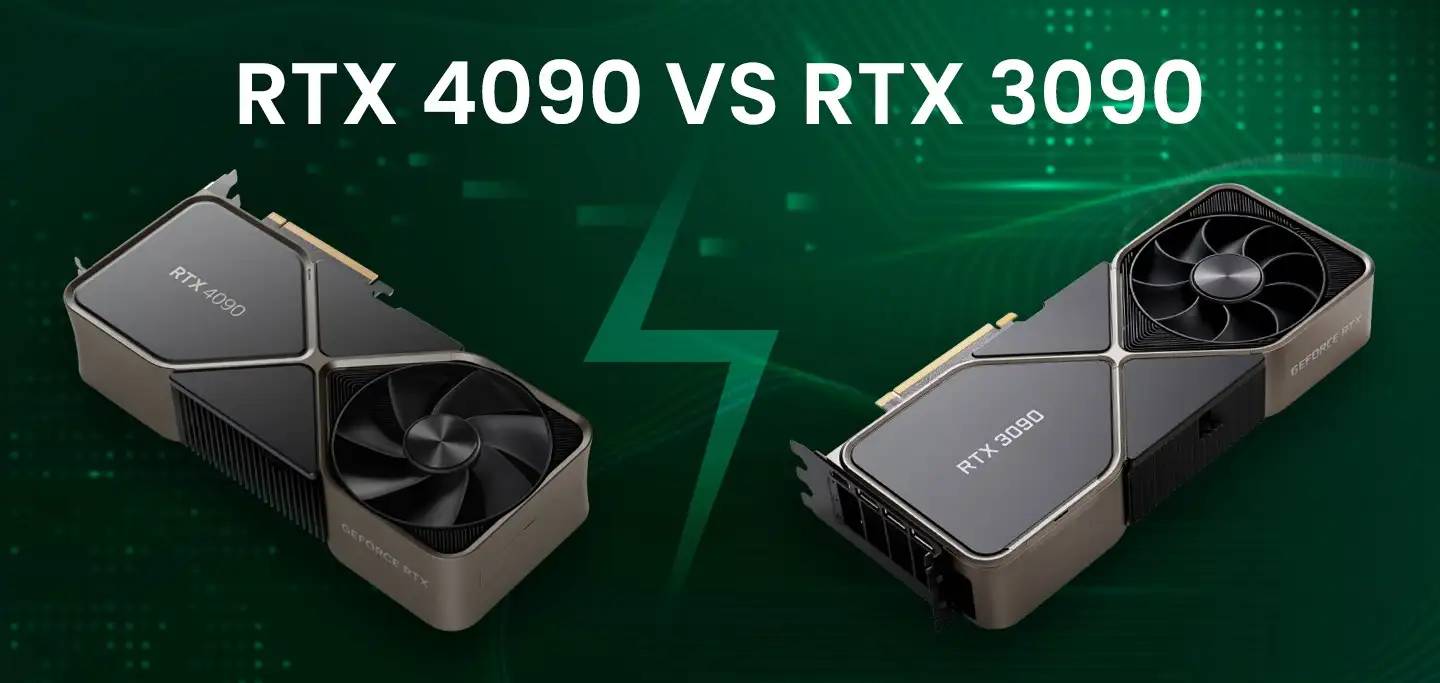
Released on October 12th, 2022, the NVIDIA GeForce RTX 4090 became the newest flagship GPU for gamers, content creators, and deep-learning researchers. Its arrival sparked immediate interest in how it stacks up against its predecessor, the NVIDIA GeForce RTX 3090, especially in the context of deep learning workloads. In this post, we dive into a detailed benchmark comparison of these two GPUs, focusing on their performance for deep learning model training.
By the end of this article, you'll understand the strengths and weaknesses of each GPU and be able to make an informed decision on which card is best suited for your deep learning needs.
The NVIDIA GeForce RTX 4090 brings several key improvements over the RTX 3090, making it a compelling option for deep learning:
Let's now delve into the specific performance metrics, comparing both GPUs in terms of training throughput, cost-efficiency, and power efficiency.
The core metric for evaluating a GPU’s performance in deep learning is its training throughput, measured in terms of how many samples it can process per second when training a model. Here’s a look at the training throughput for both the RTX 3090 and RTX 4090 across several popular models, including ResNet50 (vision), SSD (object detection), and TransformerXL (natural language processing).
| GPU/Model | ResNet50 (Images/sec) | SSD (Images/sec) | BERT Base (Tokens/sec) | TransformerXL (Tokens/sec) | Tacotron2 | NCF (Recommendations/sec) |
|---|---|---|---|---|---|---|
| RTX 3090 TF32 | 144 | 513 | 85 | 12101 | 25350 | 14714953 |
| RTX 3090 FP16 | 236 | 905 | 172 | 22863 | 25018 | 25118176 |
| RTX 4090 TF32 | 224 | 721 | 137 | 22750 | 32910 | 17476573 |
| RTX 4090 FP16 | 379 | 1301 | 297 | 40427 | 32661 | 32192491 |
Across all tested models, the RTX 4090 demonstrates a significant improvement in training throughput over the RTX 3090, particularly in FP16 precision, which is often used to accelerate training without sacrificing too much accuracy. For instance:
Overall, the RTX 4090 shows 1.3x to 1.9x higher training throughput than the RTX 3090 depending on the model and precision settings.
While performance is critical, cost-efficiency is another important factor, especially for researchers and students working on tight budgets. The price of the RTX 4090 is set at $1599, while the RTX 3090 costs $1400. When we normalize the results for training throughput per dollar, the RTX 4090 still leads in most cases.
For individuals or institutions looking to maximize their return on investment, the RTX 4090 provides better long-term value despite the slightly higher initial cost.
Power consumption is another factor to consider, especially for users operating in environments where energy efficiency is a concern. The RTX 4090's 450W power consumption is significantly higher than the RTX 3090’s 350W. Despite this, when normalized for training throughput per watt, the RTX 4090 remains competitive.
Multi-GPU setups are crucial for large-scale deep learning projects, where training times need to be minimized across even larger datasets. Although the RTX 4090 no longer supports NVLink (NVIDIA’s high-bandwidth interconnect technology), it still scales effectively in multi-GPU configurations using the PCIe Gen 4 interface.
Before purchasing the RTX 4090 for deep learning, there are a few factors to keep in mind:
The NVIDIA GeForce RTX 4090 is a powerful GPU that offers substantial improvements over its predecessor, the RTX 3090, for deep learning workloads. With up to 1.9x higher training throughput, better cost-efficiency, and comparable power efficiency, the RTX 4090 is an excellent choice for deep learning practitioners, especially those looking to balance performance and budget.
While its size and power consumption may be drawbacks for some users, the performance gains are undeniable. Whether you’re a student, researcher, or creator working with machine learning models, the RTX 4090 provides the horsepower needed for faster training times and more complex models. Additionally, the card scales well in multi-GPU configurations, making it a solid option for large-scale deep learning projects.
In the future, we anticipate more comprehensive benchmarks, including FP8 performance and broader model tests, which will further solidify the RTX 4090’s position as a leader in the deep learning space.
For more info visit www.proxpc.com
Resources you may find helpful.

Harness the power of GPU servers to revolutionize business operations with unparalleled performance in AI, data analysis, and rendering tasks.
Best GPUs for AI and deep learning in 2024: NVIDIA's RTX 4090, A6000, A100, and more, benchmarked for performance and efficiency

Keep your computer running smoothly with these 10 essential tips. From regular backups to cleaning dust and updating software, ensure optimal performance and longevity.
Dual vs. single CPU: Which is right for you? Learn how workload, software compatibility, budget, and scalability influence your decision for better computing.