Deploying Large Language Models (LLMs) in production environment requires a deep understanding of memory architecture.
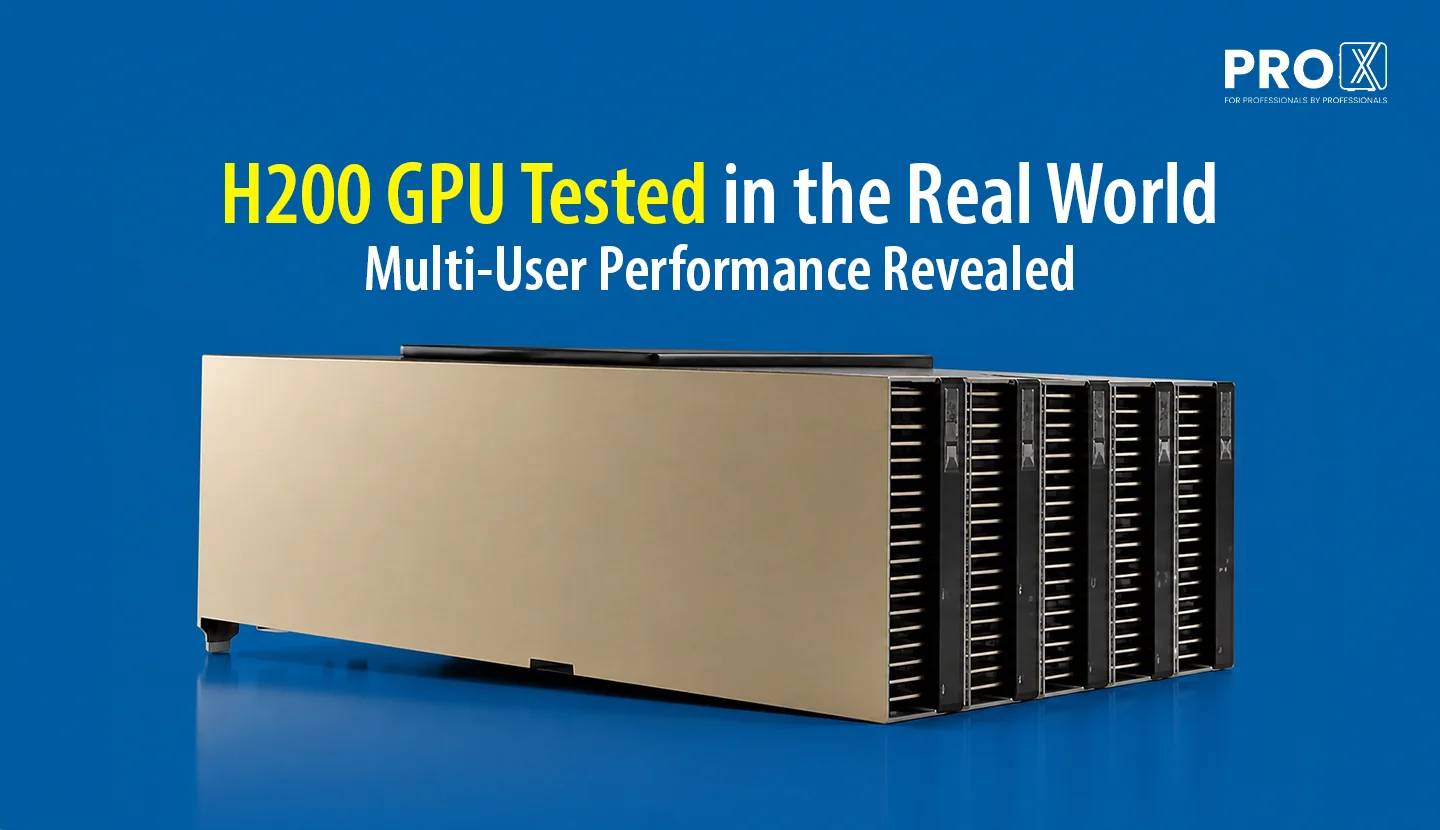
Deploying Large Language Models (LLMs) in production environment requires a deep understanding of memory architecture. When multiple users interact with an AI simultaneously, the hardware demand increases dramatically. For a highly effective AI infrastructure, we must look at how the NVIDIA H200 GPU handles these intensive workloads and explore the architectures required to support enterprise-scale concurrency.
The NVIDIA H200 GPU introduces a massive upgrade in memory capacity and speed. It features 141GB of HBM3e (High Bandwidth Memory), delivering an astonishing 4.8 TB/s of memory bandwidth.
This specific architecture enables maximum model size a single GPU can run. In generative AI, the model's weights (its core knowledge) must reside entirely within the GPU's VRAM.
With 141GB of memory, a single H200 comfortably loads a dense 72B parameter model (like Qwen2.5-72B) at 16-bit or 8-bit precision, leaving ample room for user interaction.
It can even support massive 120B+ parameter models (like Nemotron-3-Super-120B or Qwen3.5-122B) using highly efficient FP8 quantization.
Having the capacity to hold these massive models on a single card drastically reduces latency, as the system avoids communicating across multiple GPUs.
Running a model is only the first step. True challenge emerges when multiple users start chatting with it.
Every time an LLM generates a new word, it needs to remember entire conversation history to maintain context. To keep responses fast, the GPU stores this ongoing context in a specialized memory allocation called the Key-Value (KV) Cache.
As your user base grows, this KV cache grows exponentially. If you have 1,000 concurrent users, the GPU must store 1,000 separate conversation histories in its ultra-fast HBM3e memory. Very quickly, the KV cache consumes all available VRAM, preventing the server from accepting new users even if the GPU's compute cores have plenty of processing power left.
To provide our clients with accurate deployment metrics, our engineering team at ProX PC conducted rigorous multi-user benchmarking on the H200. We tested maximum healthy concurrency, the highest number of simultaneous users the system can support while maintaining comfortable reading speeds (around 10 to 25 tokens per second per user).
Here is the real-world performance data from our labs:
| Model | Peak Aggregate Throughput (tok/s) | Users at Peak Throughput | P50 Latency (s) | P95 Latency (s) | Tokens/s per User | Max Healthy Concurrency | Recommended Production Users |
|---|---|---|---|---|---|---|---|
| Llama-3.1-8B-Instruct | 20,315.44 | 1024 | 21.981 | 22.245 | 24.58 | 2000 | 2000 |
| Qwen3-Coder-Next-FP8 | 10,175.65 | 512 | 24.579 | 24.928 | 20.8 | 1548 | 1548 |
| Gemma-3-27b-it | 5,139.51 | 256 | 24.663 | 24.71 | 20.82 | 1024 | 1024 |
| Qwen2.5-72B | 3,493.91 | 512 | 46.309 | 54.792 | 8.67 | 1024 | 1024 |
| Qwen3.5-122B-A10B-FP8 | 389.81 | 64 | 43.955 | 83.996 | 9.14 | 1024 | 64 |
| NVIDIA-Nemotron-3-Super-120B | 345.75 | 64 | 53.639 | 94.661 | 9.09 | 64 | 64 |
Looking at the raw data reveals exactly how a server behaves under stress. Here is how to interpret these numbers for your own deployment:
P50 vs. P95 Latency: P50 is your average user experience. However, P95 shows the worst-case scenario (the latency experienced by the slowest 5% of requests). Notice how on the heavier models, the P95 latency spikes significantly. A stable enterprise deployment requires hardware that keeps P95 latency within acceptable limits.
Peak Aggregate Throughput vs. Tokens/s per User: Aggregate throughput is the total output of the server. Tokens per user is what the individual human actually sees. A human reads comfortably at about 10-15 tokens per second. We must balance the total users so that individual reading speed remains high.
The Concurrency Gap (Max vs. Recommended): Look closely at the Qwen3.5-122B model. While the server can physically accept 1,024 concurrent connections without crashing (Max Healthy Concurrency), the latency spikes to a massive 83 seconds (P95) and the token generation drops. Therefore, to ensure a usable, responsive experience, we cap the Recommended Production Users at 64.
Our data shows that a well-optimized H200 can support massive concurrency for smaller, highly efficient models. However, as we scale to highly complex 72B and 120B models, the KV cache requirements restrict the total number of users, even with 141GB of VRAM.
To solve this multi-user bottleneck, at ProX PC we can also implement a highly specialized storage architecture. With our partnership with MiPhi to integrate aiDAPTIV+ technology (Read more about it) into our enterprise servers.
This technology fundamentally changes how the system handles KV cache. Rather than forcing all conversation histories to reside strictly inside the expensive GPU VRAM, aiDAPTIV+ intelligently offloads the KV cache onto MiPhi NVMe solid-state drives.
By utilizing NVMe storage as an extension of the GPU memory, we dramatically increase the available space for user context. This architecture enables organizations to support significantly more concurrent users on massive models without encountering the traditional VRAM ceiling.
(Reach out to us if you want this solution)
Designing infrastructure for hundreds or thousands of simultaneous AI users requires a proper solution. Our team designs specific hardware topologies to match your exact user load and model requirements.
For departmental workloads and mid-sized deployments, we configure highly efficient 4-GPU 2 in1 server (Pro Maestro GQ A) that provide a powerful foundation for local LLM inference. For enterprise-scale applications demanding maximum throughput and massive concurrency, our heavy-duty 10-GPU H200 server (Pro Maestro GD) deliver the exact computational density required to support your entire organization.
For enterprise-scale deployment, the NVIDIA H200 is currently the best GPU for AI LLM workloads. Its massive 141GB of ultra-fast HBM3e memory provides the exact capacity and bandwidth required to run complex, high-parameter AI models with minimal latency.
If you are building a professional workstation, cards like the NVIDIA RTX PRO 6000 Ada Generation lead the pack with 48GB of VRAM. However, for true server-grade power, the PCIe and SXM versions of the NVIDIA H200 offer an unmatched 141GB of memory, making it the absolute highest capacity option for heavy AI inference.
KV (Key-Value) cache is the memory an AI model uses to remember the context of an ongoing conversation. Every active user requires their own KV cache. If too many people use the AI at once, this cache fills up the GPU's VRAM entirely, preventing the system from answering new queries.
This depends entirely on the size of the AI model. Based on our ProX lab testing, a single H200 can support up to 2,000 concurrent users on a highly efficient 8B parameter model. However, for massive 120B+ parameter models, the recommended user count drops to around 64 to ensure fast, readable responses.
A 4-GPU server, like our Pro Maestro GQ A, is the perfect foundation for departmental workflows and mid-sized LLMs. If you are deploying an enterprise-wide AI assistant for hundreds of simultaneous users, or training massive datasets, you will need the extreme computational density of a 10-GPU server like the Pro Maestro GD.
Resources you may find helpful.

Harness the power of GPU servers to revolutionize business operations with unparalleled performance in AI, data analysis, and rendering tasks.
The power of NVIDIA® GeForce RTX 4090: Redefining deep learning benchmarks, exceeding expectations set by the RTX 3090

Best GPUs for AI and deep learning in 2024: NVIDIA's RTX 4090, A6000, A100, and more, benchmarked for performance and efficiency

Keep your computer running smoothly with these 10 essential tips. From regular backups to cleaning dust and updating software, ensure optimal performance and longevity.