We have all, at least once, had this thought while working on AI: what if we could upgrade GPU VRAM just like we upgrade our system storage? What if we could expand the GPU memory pool using NVMe?
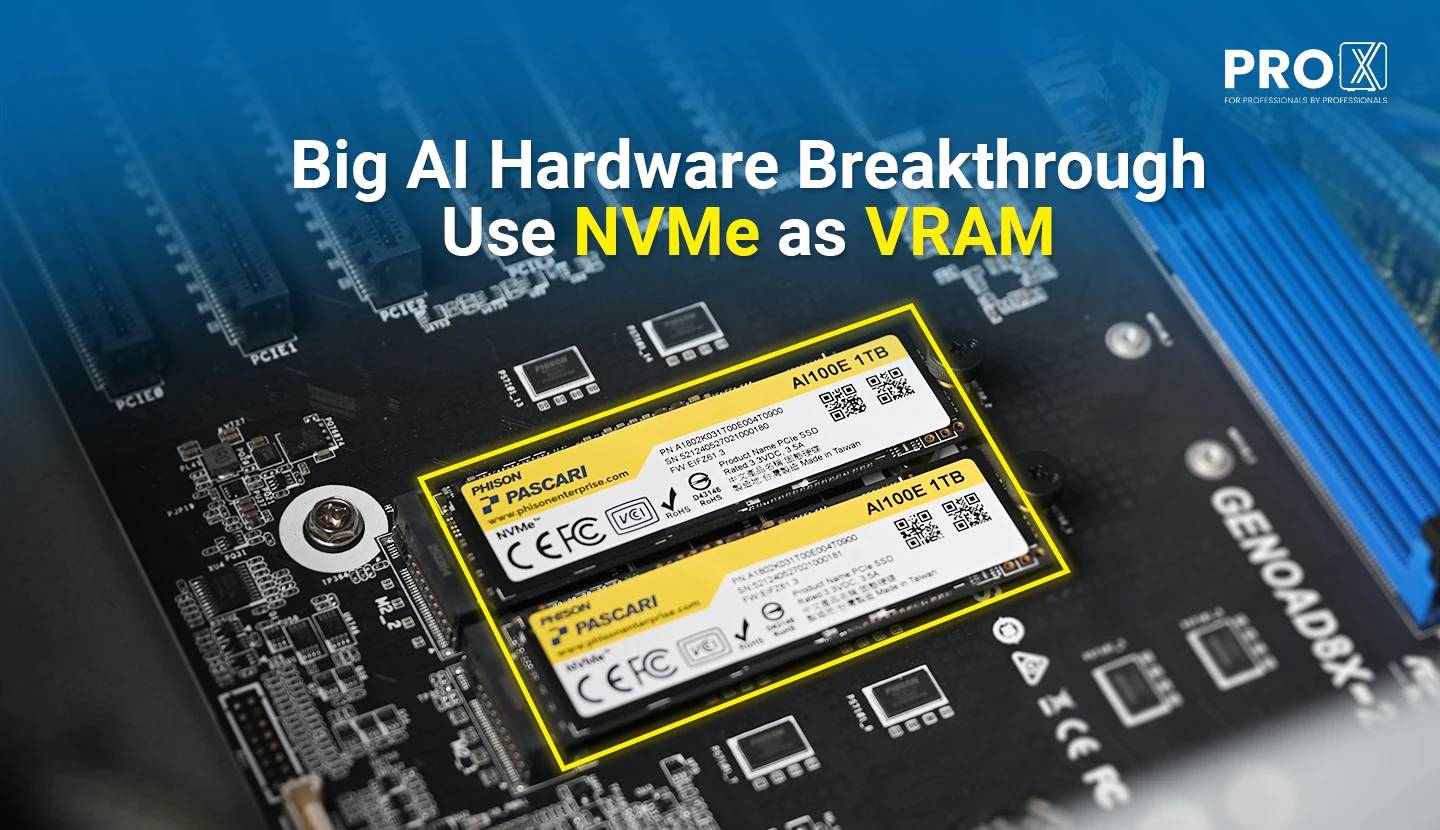
We all have, at least once, had this thought while working on AI: what if we could upgrade GPU VRAM just like we upgrade our system storage? What if we could expand the GPU memory pool using NVMe?
Well, that thought is a reality today. We have catapulted entirely past the theory phase and completed exhaustive testing in the ProX PC labs, and only after verifying the hard data are we claiming this success and sharing this breakthrough with you.
Whenever we attempt to run massive parameter models locally, the memory wall halts our progress. For a long time, the standard approach to holding massive weights in memory involved stacking multiple enterprise GPUs together.
However, relying entirely on traditional GPU scaling creates a very specific architectural flaw alongside severe physical and financial barriers:
Forced Compute Scaling: As model sizes increase without proportional growth in GPU VRAM, memory becomes the limiting factor. This forces organizations to scale by adding more GPUs and nodes bringing additional networking and compute overhead.
Massive Financial Investment: Acquiring multiple enterprise-grade GPUs demands an enormous hardware budget, especially when you only needed the memory component.
Infrastructural Strain: Multi-GPU clusters produce massive thermal output and require highly complex cooling solutions.
Extreme Power Consumption: Stacking computational hardware exponentially increases the electrical draw of the server rack.
At ProX PC, our engineering team dedicated months to analyzing this specific bottleneck. We actively sought a more intelligent architectural approach that expands memory pools logically. This pursuit led us to a strategic partnership with MiPhi, who sent us their specialized 2x 1TB aiDAPTIVCache NVMe drives directly to our testing labs.
Why MiPhi aiDAPTIVCache drives are different from standard NVMe: Standard SSDs are designed for occasional storage and would fail within days under the constant data-swapping required by AI. MiPhi’s specialized architecture is purpose-built for this task:
Extreme Endurance (100 DWPD): Traditional enterprise SSDs are rated for 1 to 3 Drive Writes Per Day (DWPD). MiPhi’s aiDAPTIVCache uses specialized SLC NAND to achieve a massive 100 DWPD rating. This allows it to handle hundreds of terabytes of data movement daily without wearing out.
The aiDAPTIV+ architecture adapts dynamically depending on the specific phase of your AI workflow. It manages data differently to optimize performance for both model development and final deployment.
The Training Phase: Slicing the model during fine-tuning, massive parameter models demand immense memory capacity. The aiDAPTIVLink middleware acts as the essential bridge between the PyTorch library and your system's hardware to handle this load.
Callback Interception: PyTorch contains internal callbacks that trigger when the system reaches its physical VRAM limit. The aiDAPTIVLink middleware actively intercepts these signals to maintain continuous operation.
Strategic Placement: aiDAPTIVLink Middleware divides the large model into smaller segments, known as slices. The system places the active slices directly onto the physical GPU for immediate mathematical processing. Simultaneously, all the remaining pending slices wait securely on the aiDAPTIVCache (NVMe).
Continuous Swapping: As soon as the GPU finishes a processing round on an active slice, the middleware moves that data back to the aiDAPTIVCache. It immediately pulls the next pending slice onto the GPU to continue the compute cycle.
The Inference Phase: During inference, the system shifts from model execution to efficient reuse of Key-Value (KV) cache, treating it as a persistent memory layer rather than a temporary GPU artifact.
In standard deployments, when a request is processed:
KV cache is created in GPU VRAM.
Due to limited memory, this cache is evicted when space is needed.
If the same prompt or context appears again, the model must:
Recompute the entire KV cache from scratch.
This increases Time To First Token (TTFT) and wastes compute.
Instead of discarding KV cache, we store it in aiDAPTIVCache.
This transforms KV cache into a reusable, persistent artifact:
When a similar or identical request comes in:
The system retrieves KV cache directly from aiDAPTIVCache.
Avoids recomputation entirely.
GPU memory is now used only for active decoding, not long-term storage.
Eliminates repeated KV generation for identical or overlapping prompts.
Since prefill is skipped or reduced:
Responses start significantly faster.
NVMe provides orders of magnitude more capacity than VRAM.
Enables caching of:
Long documents
Multi-turn conversations
Reusable prompt templates
Shared KV cache across users:
Popular prompts or documents don’t need recomputation per user.
This is where the approach becomes especially powerful.
Every query:
Retrieve documents
Recompute KV cache for the retrieved context
This becomes expensive when:
Same documents are repeatedly retrieved
Multiple users query similar knowledge bases
Instead of transferring KV cache using the inference engine’s small native page size, aiDAPTIV+ operates at a configurable chunk level, typically much larger. This allows the system to better utilize the available bandwidth between aiDAPTIVCache and GPU memory, resulting in more efficient data movement and faster KV cache loading.
Precompute KV cache for:
Knowledge base documents.
PDFs, manuals, embeddings context.
Store them in aiDAPTIVCache once.
At inference:
Instead of recomputing document KV cache:
Fetch cached KV directly from aiDAPTIVCache.
Only compute KV for the new query tokens
In enterprise systems:
Multiple users query the same document (e.g., internal docs, policies)
With aiDAPTIV+ KV caching:
Shared document KV cache is reused across all users
Avoids:
Redundant computation
GPU memory pressure
Faster responses for repeated queries
Higher throughput for concurrent users
Enables large-scale, low-latency RAG deployments
Now, we move from the architecture to the exact data. Our engineering team at ProX PC put this integration through rigorous testing to see exactly how it performs under heavy, enterprise-level workloads.
To understand the magnitude of these results, we must look at the hardware requirements of fine-tuning a large parameter platform like Llama 3.1 70B. Fine-tuning this 70B platform in FP32 precision requires roughly 1.4TB of total memory to securely hold the base weights alongside the massive additional overhead of gradients and optimizer states.
A standard RTX PRO 6000 provides 96GB of VRAM, and an RTX 5090 provides 32GB. Attempting to run this 1.4TB fine-tuning workload on a single GPU immediately hits an out-of-memory error. To run this setup using a traditional architecture, an organization is forced to purchase and link a massive multi-GPU cluster.
By utilizing the 2x 1TB MiPhi aiDAPTIVCache NVMe drives as an active VRAM pool, we bypassed this physical limit entirely on a single-node ProX PC server. The NVMe pool successfully held the parameter weights and fine-tuning states, paging them to the active GPU memory with high efficiency.
| Precision | Platform | GPU | Tokens/s | Power Draw | NVMe Utilization (2x 1TB) |
|---|---|---|---|---|---|
| FP16 | Llama-3.1-8B | RTX PRO 6000 | ~2,973 – 3,386 +1 | 408W | 417GB |
| FP16 | Llama-3.1-8B | RTX 5090 | ~2,337 +1 | 563W | 407GB |
| FP16 | Llama-3.1-70B | RTX PRO 6000 | 400 | 560W | 1.6TB |
| FP16 | Llama-3.1-70B | RTX 5090 | ~190 +1 | 508W | 1.4TB |
| FP32 | Llama-3.1-8B | RTX PRO 6000 | 797.266 | 475W | 560GB |
| FP32 | Llama-3.1-8B | RTX 5090 | 607.136 | 510W | 407GB |
| FP32 | Llama-3.1-70B | RTX PRO 6000 | 770.425 | 390W | 1.6TB |
| FP32 | Llama-3.1-70B | RTX 5090 | 40.997 | 514W | 1.4TB |
Note on scaling: We also pushed the system to load the Llama-3.1-405B for fine-tuning evaluation. This massive model exceeded our initial 2TB NVMe storage limit and system was unable to run it.
Our RTX PRO 6000 benchmarks prove that resolving the GPU memory bottleneck through aiDAPTIV+ is highly effective. A single GPU can now handle massive workloads like Llama 3.1 70B fine-tuning that previously required an entire server rack.
By creating the massive memory pool through aiDAPTIV+ with intelligent PyTorch integration, we empower industries to achieve true localized AI fine-tuning.
At ProX PC, we are fully integrating MiPhi aiDAPTIV+ technology into our hardware ecosystem and We sincerely thank the team at MiPhi for this partnership. By collaborating closely, we built a practical, powerful solution that fundamentally expands the possibilities of localized AI deployment.
How to increase GPU VRAM without upgrading the GPU?
Integrate aiDAPTIV+ middleware with specialized NVMe drives to create a unified memory pool. This allows a single GPU to process massive models like Llama 3.1 70B by using storage as logical VRAM.
Can NVMe be used as VRAM?
Yes, aiDAPTIVLink middleware connects your software to the hardware to swap data "slices" between the GPU and NVMe. The system intercepts memory signals to maintain operation even when the physical VRAM limit is reached.
What is GPU memory expansion?
This technology uses high-endurance SLC NAND drives as an active memory layer for the GPU. It bypasses physical hardware limits by storing model weights and training states on NVMe instead of requiring multiple expensive GPUs.
Is NVMe faster than VRAM?
VRAM remains the fastest location for immediate mathematical processing. However, aiDAPTIV+ makes NVMe highly efficient by paging only the necessary data to the GPU for each compute cycle, providing the massive capacity that standard VRAM lacks.
Can a standard SSD replace GPU memory?
Standard enterprise SSDs fail quickly because they lack the endurance for constant AI data swapping. You must use specialized drives with a 100 DWPD (Drive Writes Per Day) rating to handle these heavy workloads safely.
📞 011-40727769
✉️ sales@proxpc.com
or check out our Server solutions
Resources you may find helpful.

AI is revolutionizing the hardware industry by boosting design, manufacturing, maintenance, supply chains, personalization, autonomy, security, and energy efficiency.
Discover model-inferencing workstations: advanced AI systems revolutionizing industries from retail to smart cities and mastering complex tasks with cutting-edge technology.
Explore how hybrid systems revolutionize transportation, energy, manufacturing, and daily life by integrating diverse technologies for innovative solutions.

Delve into Edge AI's impact on latency, privacy, and autonomy. Uncover its applications in healthcare, manufacturing, retail, and security.