Molecular dynamics (MD) is one of the most demanding things you can ask a computer to do.
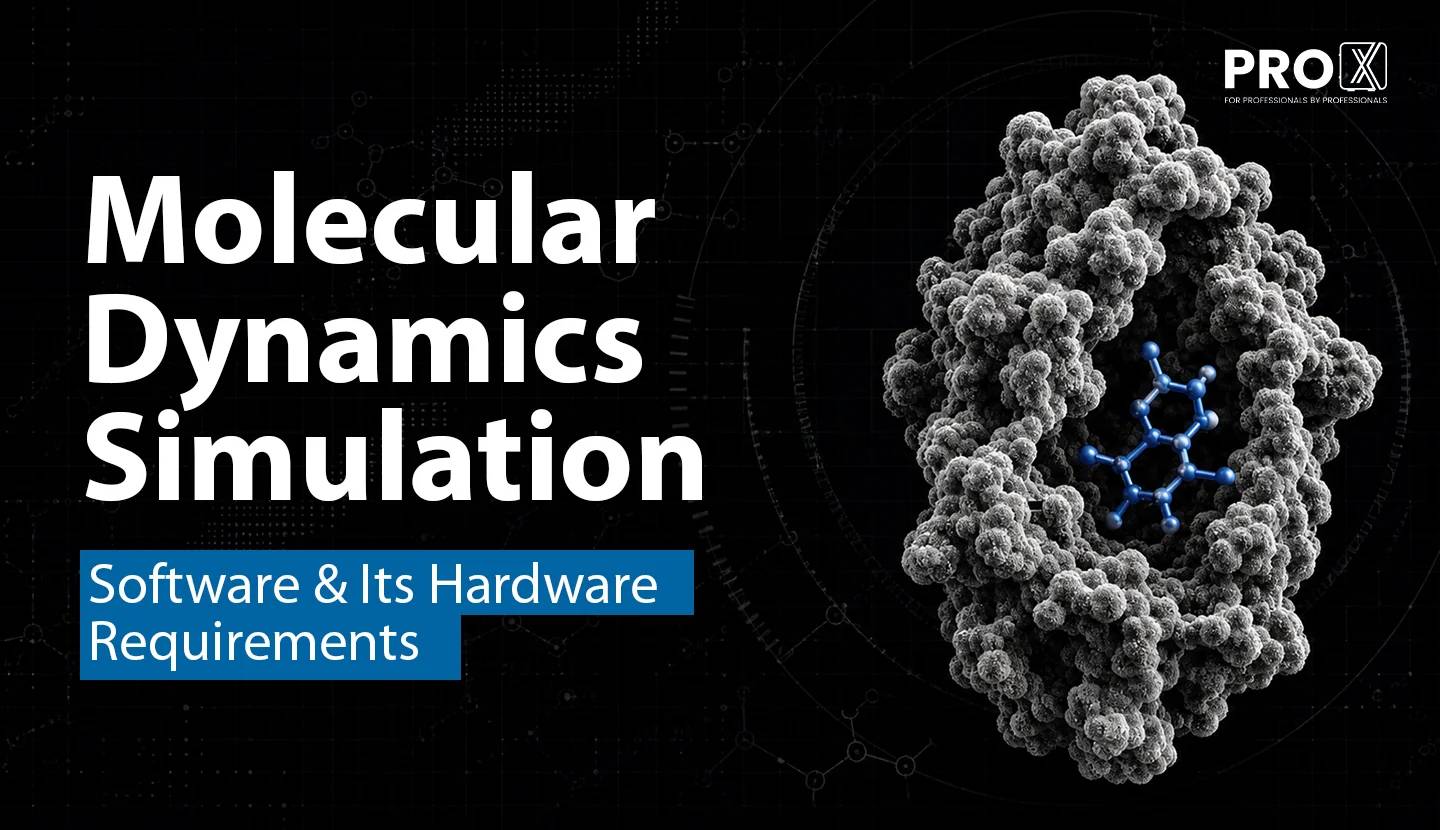
Molecular dynamics (MD) is one of the most demanding things you can ask a computer to do. You are simulating the motion of thousands to millions of atoms, one femtosecond at a time, often for days on end, just to watch a single microsecond of molecular life unfold. The software that makes this possible has matured beautifully. The hardware underneath it, however, is still where most research groups either win back weeks of time or quietly lose them.
At ProXPC, we build the machines that run this software for a living. Over the years we have configured, tested, and supported systems for GROMACS, LAMMPS, NAMD, AMBER, and more, and we have seen the same avoidable mistakes cost labs real research time. This guide brings that experience together in one place: what the major MD packages are, how they actually use your hardware, and what a properly matched workstation looks like. If you would rather skip ahead and talk it through, our engineers are on 011-40727769. Otherwise, read on.
Molecular dynamics is not a single program. It is a family of engines, each with its own strengths, its own community, and its own relationship with hardware. Choosing hardware well starts with knowing which of these you will actually run.
GROMACS is among the fastest MD engines available and a default choice for biomolecular work such as proteins, lipids, and solvated systems. It is heavily GPU-optimized and famously efficient on a single well-balanced machine, which makes it a natural fit for a deskside workstation rather than only a cluster.
LAMMPS is the workhorse of materials science and soft-matter research. It is extraordinarily flexible, scales well across many cores and multiple GPUs, and is often used for very large systems, coarse-grained models, and custom force fields. That flexibility is its strength, and it also means its hardware needs vary widely depending on what you are modeling.
NAMD is built for high-performance simulation of large biomolecular systems and is well known for scaling across GPUs and nodes. It pairs closely with visualization in VMD and is a common choice for large membrane proteins and complex molecular assemblies.
AMBER is a long-established suite for biomolecular simulation, especially strong in nucleic acids, proteins, and free-energy work. Its GPU-accelerated engine (pmemd.cuda) is highly efficient, and much of its performance rides on a single strong GPU rather than a large core count.
Other tools such as OpenMM, Desmond, and CHARMM round out the landscape, and many researchers use more than one. The important point is that these engines share a common performance DNA even as they differ in the details, and that shared DNA is what should drive your hardware decisions.
To buy the right machine, it helps to picture what these programs are doing millions of times per run. In each timestep, the software computes the forces acting on every atom, updates their positions and velocities, and then repeats, usually at femtosecond resolution. That means a single microsecond of simulated time can involve a billion timesteps. Performance is measured in nanoseconds simulated per day (ns/day), and every hardware choice is ultimately a bet on pushing that number higher.
The force calculation is where the cost lives. It splits into short-range non-bonded interactions (usually the largest cost), long-range electrostatics handled by methods like particle-mesh Ewald (PME), and bonded interactions. Modern MD engines push most of this work onto the GPU, while the CPU keeps the GPU fed, handles domain decomposition, and manages the parts of the timestep that stay on the host. Think of it as a kitchen: the GPU is the chef doing the heavy cooking, and the CPU is the sous-chef prepping ingredients fast enough to keep the chef moving. When the two are in balance, the GPU stays saturated and the CPU comfortably keeps pace. When they are not, one component sits idle while the other struggles, and your ns/day suffers.
This overlap model is the single most important thing to understand, because it explains why balance beats brute force. A powerful GPU starved by a weak CPU underperforms, and an enormous CPU attached to a modest GPU wastes most of its cores on a single job. Good MD hardware is not the most of everything. It is the right ratio for the way you work.
For the majority of modern MD workloads across GROMACS, NAMD, AMBER, and GPU-accelerated LAMMPS, the GPU is the single most performance-defining component. A strong GPU can outrun a large multi-socket CPU-only system on the same simulation. GPU memory capacity matters less than people assume for one simulation, but it becomes critical the moment you want to run several simulations on one card or handle very large systems. This is why serious MD workstations are built GPU-first.
A common instinct is that more cores always means faster simulation. For GPU-accelerated MD, that is only partly true. Once the GPU is doing the force work, the CPU role is to feed it efficiently, which rewards strong per-core performance and a sensible core count rather than the absolute maximum. High core counts genuinely pay off in two situations: running many simulations at once, and scaling across multiple GPUs. For a single job, a very high-core CPU can sit largely idle.
MD is generally less memory-hungry than CFD or FEA, and even large systems rarely need the maximum available RAM. What you are really buying memory for is headroom for very large or many concurrent systems, plus the bandwidth that keeps multi-core CPU work efficient. Modern DDR5 with capacity matched to your workload is the right approach, rather than overprovisioning by reflex.
MD runs write trajectory and checkpoint files continuously, and long simulations generate a great deal of data. A fast Gen4 NVMe drive as scratch storage keeps frequent checkpoint writes from becoming a bottleneck, while larger secondary storage handles trajectory archiving. Treating these as two separate tiers keeps both speed and capacity where they are needed.
A production run can last days or weeks without interruption. A machine that thermally throttles loses performance, and one that crashes on day four can corrupt an entire run and cost you the time already spent. This is where a properly engineered workstation earns its place: cooling and a high-efficiency power supply sized for sustained full-load operation, and genuine burn-in testing before the machine ever reaches you. It is the least glamorous part of the spec and often the most important.
"Maximum cores mean maximum speed." Not for a single GPU-accelerated simulation. Extra cores help mainly with concurrency and multi-GPU scaling. For one run, that budget is better spent on the GPU.
"All GPUs are basically the same." Consumer cards can run MD well, especially in single precision, but sustained around-the-clock compute, larger memory needs, ECC, and reliability under multi-day load are where professional cards prove their value. The right choice depends on your actual workload, not a blanket rule.
"More RAM always means faster runs." MD is rarely memory-bound. Past what your system size needs, extra RAM simply sits unused.
"Double precision is safer, so use it everywhere." Most MD engines are optimized for single precision, which is both faster and validated as accurate for the overwhelming majority of work. Double precision is needed only in specific edge cases and can roughly halve performance elsewhere for no practical benefit.
"A workstation cannot compete with cluster or cloud time." For many labs, a well-balanced deskside machine delivers more usable, predictable throughput than queuing for shared clusters or paying ongoing cloud bills, with the added benefit of keeping your data in-house. When you genuinely outgrow one machine, that is the moment to scale to a multi-GPU server, not before.
Here is the honest reality of buying a simulation machine in India. Most vendors sell you a configuration. Very few actually understand what happens when GROMACS offloads PME to the GPU, why NAMD scales the way it does, or how AMBER GPU engine changes the ideal CPU-to-GPU balance. That gap is exactly where research budgets get wasted on hardware that looks impressive on paper and underperforms in practice.
ProXPC exists to close that gap. We do not treat MD software as a checkbox on a datasheet. We build and validate our Mathematical and Molecular Modeling workstations specifically against the tools researchers run, including GROMACS, LAMMPS, NAMD, AMBER, and MATLAB, and we tune the balance of GPU, CPU, memory, and storage to the way your simulations actually behave. If you want simulation-specific hardware in India and you want it configured by people who genuinely understand the software, ProXPC is the partner built for that.
That understanding shows up in the details. Every machine is fully configurable, from a single strong GPU for focused single-project work up to dual-GPU, high-core systems that behave like a small in-house cluster. Each one ships plug-and-play with your choice of Windows 11 Pro or the latest Ubuntu with CUDA drivers pre-installed, so you can start simulating on day one instead of fighting your environment. And when your needs grow beyond any single workstation, our multi-GPU server line scales with you.
It is backed by the parts that do not appear on a spec sheet: PAN-India shipping with in-transit insurance, plug-and-play delivery with no complex setup, and Pro Standard support with a return-to-base warranty plus lifetime remote technical support. In short, the hardware is engineered, tested, and supported by people who speak your software language.
Molecular dynamics rewards balance, not excess. A strong GPU, a fast and appropriately-sized CPU, sensible memory, fast scratch storage, and cooling built for multi-day runs will get you more real science done than chasing the biggest number in any single category. The right mix depends on which software you run and how you run it, and that is precisely the conversation worth having before you buy.
If you need simulation-specific hardware in India and want a solution built by people who understand the software as well as the silicon, call ProXPC on 011-40727769 or email sales@proxpc.com. Tell us what you are simulating, and we will design a machine that is limited by physics, not by your hardware. Explore our molecular modeling workstations and multi-GPU servers to get started.
Written from the inputs of the ProXPC Engineering Team, builders of purpose-configured simulation and molecular modeling workstations for research labs, pharmaceutical R&D groups, and computational scientists across India.
Resources you may find helpful.
This complexity creates a heavy physical load on your workstation. While a standard CAD machine handles basic modeling easily, non-linear solve times often jump from minutes to hours. The following breakdown identifies the specific hardware parts that matter most for professional simulation in 2026.
Autodesk offers a versatile pricing structure, allowing teams to choose between fixed annual subscriptions for heavy users and a flexible "pay-as-you-go" model for occasional needs.
AnyLogic leads the industry in multimethod simulation modeling.
Engineers and researchers rely heavily on ANSYS to simulate real-world physics.