If you are planning an edge AI rollout in India, the first quote you get will probably have a Jetson in it.
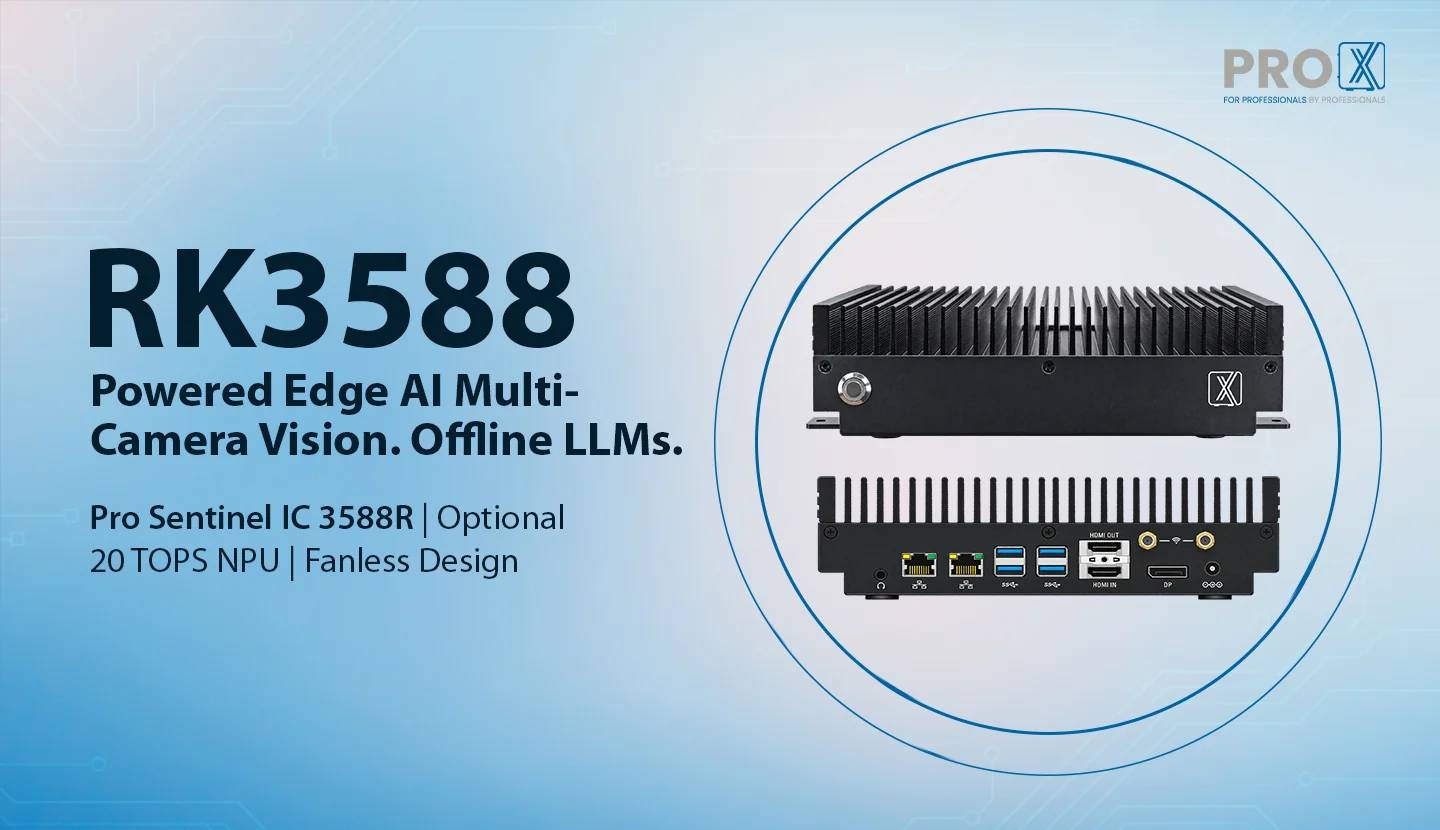
If you are planning an edge AI rollout in India, the first quote you get will probably have a Jetson in it. That makes sense. NVIDIA's Jetson modules are the default for running AI on camera feeds, and we build our own Pro Sentinel Orin and Pro Sentinel Thor devices on them.
The question is whether your job needs one. A lot of site work is steady and specific: counting people at a gate, checking helmets on a shop floor, reading number plates at a toll lane. These jobs often use a small slice of what a Jetson offers. Multiply that across 30 sites and you are paying for headroom that sits idle, like buying a delivery truck to carry a laptop bag.
The main alternative comes from Rockchip, a chip maker whose processors run AI on an NPU (neural processing unit), a part of the chip built only for AI maths, instead of a GPU. Its top chip, the RK3588, is what this guide puts to the test.
We use one device as the test case: the Pro Sentinel IC 3588R. Every number below comes from our own lab, measured on 12 November 2026, across object detection, language models, vision-language models and a 46-minute thermal soak. By the end you should know whether your workload fits a Rockchip device, where a Jetson is still the better buy, and what changes on the software side when you switch.
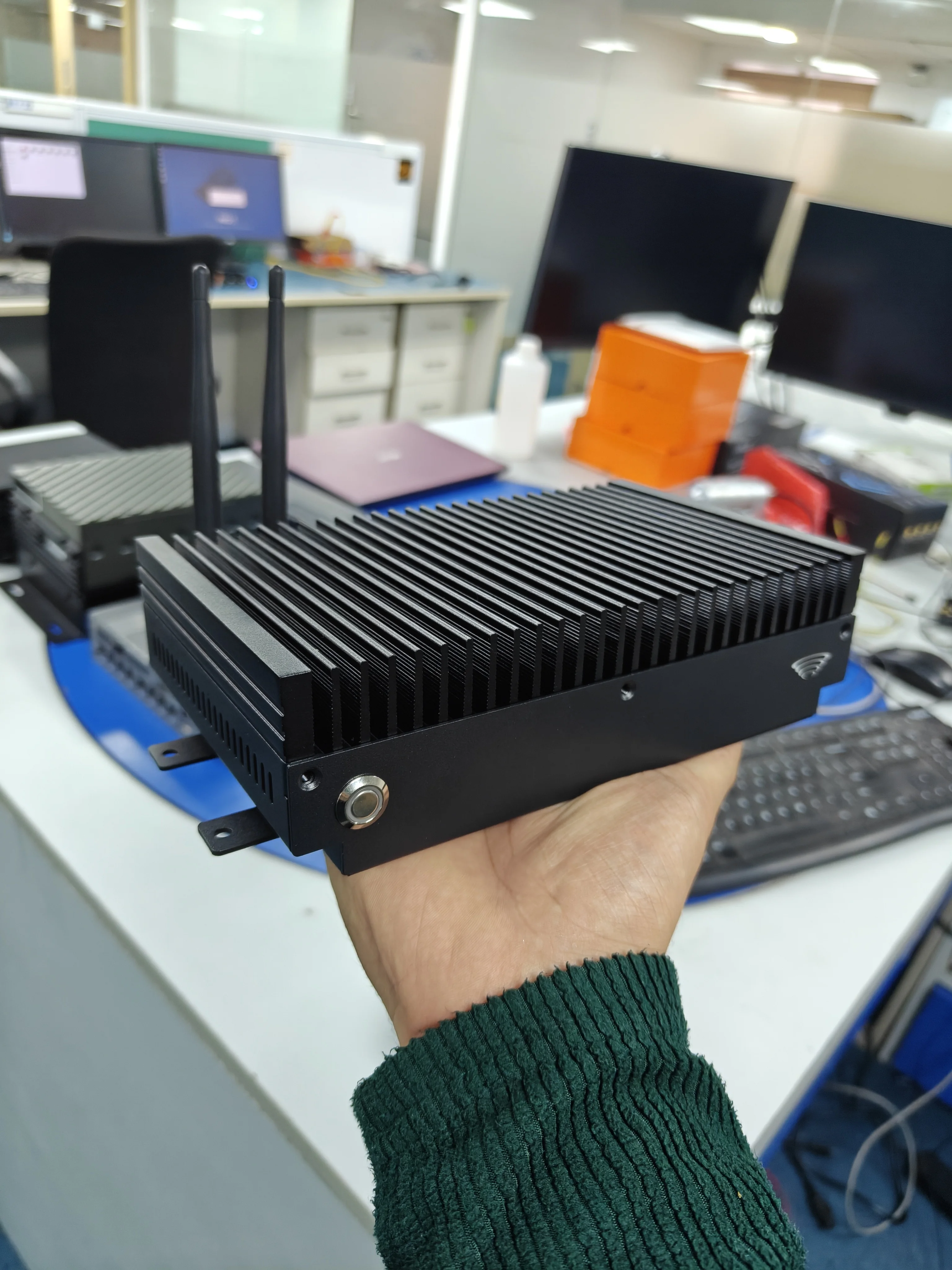
It is a compact, fanless edge AI computer, meaning a device that runs AI models right where the cameras and sensors are, so video stays on site instead of travelling to a cloud server. The whole unit measures 200 x 122 x 57 mm and cools itself through a finned aluminium housing with copper heat pipes. Inside sits the RK3588, the most capable chip in Rockchip's current lineup, and our team in India configures and supports every unit.
The interesting part is that the device can carry two AI engines, and this guide compares them often, so here is the difference. The chip NPU is built into the RK3588 itself, with three cores and 6 TOPS, and every unit has it. The NPU card is dedicated hardware that we fit inside the device on an M.2 slot when your workload calls for it, bringing 20 TOPS and its own memory. In the results below, "chip" always means the built-in NPU and "card" means the one we add. TOPS (trillions of operations per second) is the usual headline figure for AI compute, useful for rough comparison and little else.
| Category | Detail |
|---|---|
| Chip | Rockchip RK3588 |
| CPU | 4x Cortex-A76 up to 2.4 GHz + 4x Cortex-A55 up to 1.8 GHz |
| GPU | Arm Mali-G610 MP4 |
| On-chip NPU | 3 cores, 6 TOPS (INT8) |
| Optional NPU card | RK1828 M.2 accelerator, 20 TOPS (INT8), 5 GB on-card memory |
| Memory | 4 GB, 8 GB or 16 GB LPDDR5/5X |
| Storage | 32 GB, 64 GB or 128 GB eMMC, plus a TF (microSD) card slot |
| Operating system | Android or Linux (Linux kernel 6.1 as tested) |
| AI software | RKNPU driver 0.9.8, rknn-toolkit2 2.3.2, RKLLM runtime 1.3.1; RKNN3 toolkit for the card, with models from TensorFlow, MXNet, PyTorch and Caffe |
| Size | 200 x 122 x 57 mm |
| Cooling | Fanless, finned aluminium housing with copper heat pipes |
| Power input | 12 V DC |
| Operating temperature | 0 °C to 60 °C |
Here is the detail that matters most for buyers: the card brings its own 5 GB of memory. Model weights live on the card, so the main memory stays free for Linux, video decoding and your application. Think of it as hiring a contractor who turns up with his own toolbox instead of borrowing yours.
Which memory should you pick? For vision work like detection, counting and pose, 4 GB covers it. Pick 8 GB if you plan to run a language model on the chip itself, since a 4B model alone peaked at 4.3 GB in our tests on the 8 GB unit. With the NPU card fitted, language models sit in the card's own memory, so the main memory choice comes down to how much else runs alongside. 16 GB suits sites running several applications on one device. The two standard configurations are 4 GB with 64 GB storage and 8 GB with 128 GB storage, and other capacities are available on request.
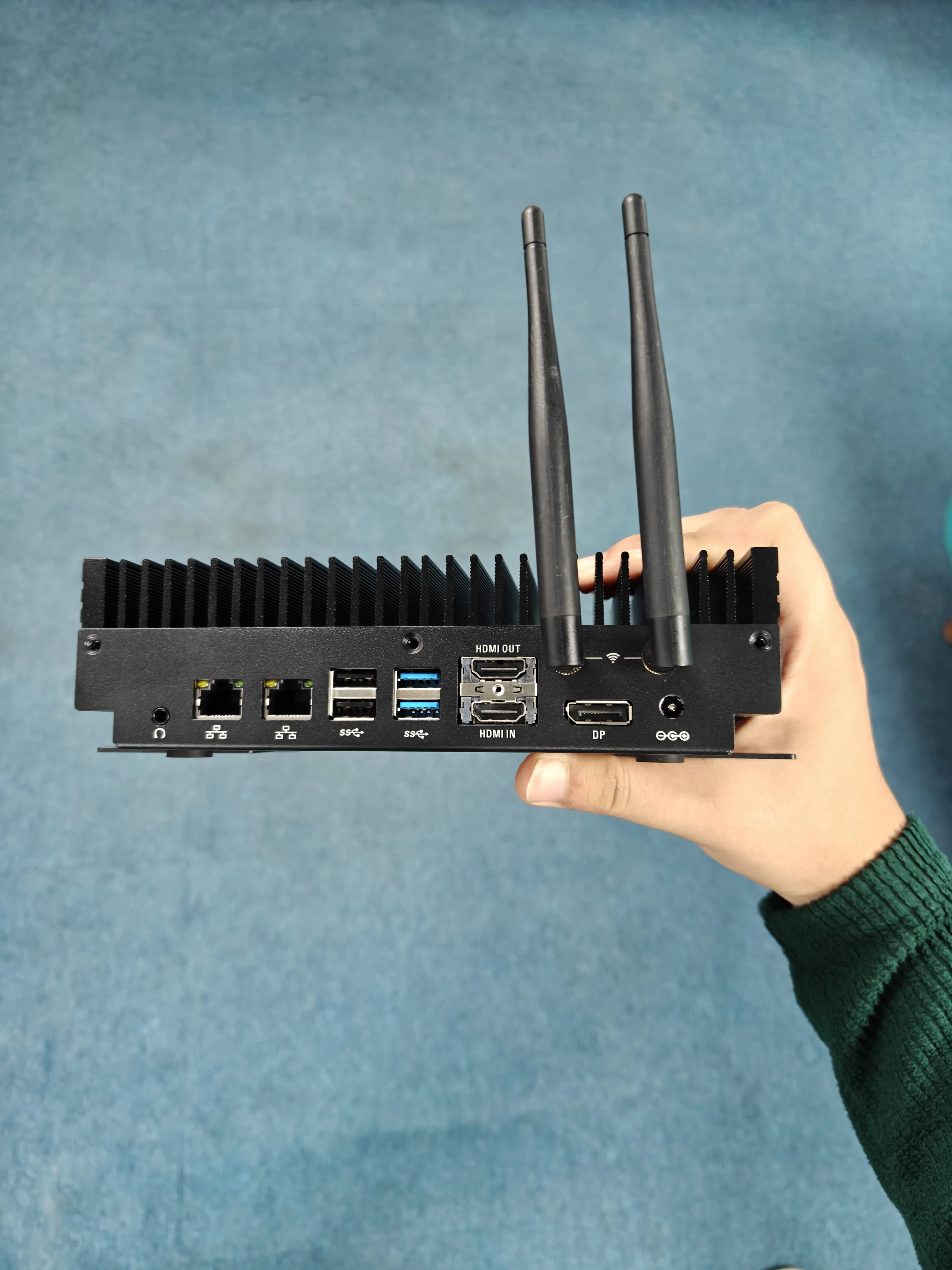
| Interface | Details |
|---|---|
| Ethernet | 2x Gigabit RJ45 |
| Wireless | Wi-Fi |
| Display output | 1x HDMI OUT, 1x DisplayPort |
| Video input | 1x HDMI IN |
| USB | 2x USB 3.0 Type-A, 2x USB 2.0 Type-A |
| Cellular | SIM slot and M.2 Key-B slot for an optional communication module, with 2 antenna connectors |
| Storage slot | 1x TF (microSD) card |
| Audio | 3.5 mm audio jack |
| Power | 12 V DC jack, side-mounted power button |
Each port solves a real site problem. Two Ethernet ports keep the camera network apart from the office network, and Wi-Fi covers spots where running a cable is a hassle. The cellular slot covers yards, fuel stations and remote sites where nobody ever laid a cable. The HDMI input is the unusual one: it lets the device take video straight from an HDMI source, such as a machine's display or a camera with HDMI out, and run AI on it without an IP camera in between.
It depends on the workload, and the test results make the split fairly clean.
| Workload | Run it on | Measured |
|---|---|---|
| Real-time detection, 1 camera | Chip NPU, YOLOv8n INT8 | 31.4 FPS |
| Real-time detection, 3 cameras | Chip NPU, one model per core | 60.3 FPS total (YOLO11s) |
| Many cameras, or keep the chip free | NPU card, YOLO11s x 8 streams | 103 FPS total |
| Fast chat assistant | Card, Qwen2.5 1.5B / Qwen3 1.7B | 135 / 114 tok/s |
| Best text quality | Card, Qwen3 8B | 58.5 tok/s |
| Questions about images | Card, Qwen3-VL 2B (speed) or Qwen3-VL 4B (quality) | 122 / 74.8 tok/s |
The short version: for up to three camera streams of detection, the chip handles it on its own. Once language models, image Q&A or a larger camera count enter the brief, the card earns its place.
One result surprised us. The card runs Qwen2.5 1.5B fifteen times faster than the chip does, a bigger gap than the TOPS figures alone would suggest.
We took official Ultralytics YOLO weights at 640x640, converted them for the RK3588 NPU and ran them in INT8. INT8 means the model's numbers are stored as 8-bit integers instead of 16-bit decimals, which makes it faster and lighter at a small cost in accuracy.
The NPU has three cores, so we tested two setups: one stream on one core, and three parallel streams with one per core, which is how a three-camera site would run.
| Model | Size (M params) | 1 stream, 1 core | 3 streams, 3 cores |
|---|---|---|---|
| YOLO11n | 2.62 | 28.4 FPS | 88.5 FPS |
| YOLO11s | 9.46 | 19.3 FPS | 60.3 FPS |
| YOLO11m | 20.11 | 9.5 FPS | 29.3 FPS |
| YOLOv8n | 3.16 | 31.4 FPS | 101 FPS |
| YOLOv8s | 11.17 | 21.3 FPS | 66.8 FPS |
| YOLOv8m | 25.9 | 11.6 FPS | 36.1 FPS |
| YOLOv8l | 43.69 | 7.0 FPS | 21.7 FPS |
With all three cores busy, models up to YOLOv8m hold 30 FPS or more. On a single core, YOLOv8n is the largest model that stays real time. FP16 builds run at roughly half the INT8 speed (YOLO11n: 44.8 vs 88.5 FPS across three cores). These figures cover the NPU work only; image decoding and the final box filtering run on the CPU.
About accuracy. FP16 on the NPU matched the CPU's full-precision result almost exactly (0.477 vs 0.478 mAP on YOLO11n), so the conversion itself loses nothing. Our quick INT8 builds, calibrated on just 100 images, lost about a third of their accuracy. Tuned calibration with mixed-precision output layers usually brings that loss down to 1 to 3 points, and that tuning is part of how we set up every unit before it ships. Treat the INT8 speeds above as representative and the quick-build accuracy as a floor.
Segmentation, pose and rotated boxes also run fully on the NPU:
| Model | 1 core | 3 cores | CPU use (3 cores) |
|---|---|---|---|
| YOLO11n-seg | 22.5 FPS | 69.1 FPS | 25% |
| YOLO11s-seg | 13.4 FPS | 44.9 FPS | 26% |
| YOLO11n-pose | 28.3 FPS | 80.1 FPS | 23% |
| YOLO11n-obb | 22.5 FPS | 64.3 FPS | 30% |
CPU use stayed between 23% and 30% during those runs, which leaves room for the rest of your pipeline.
On the card we ran the official models compiled for it, one NPU core per stream. Single-stream numbers first:
| Model | Input | FPS |
|---|---|---|
| MobileNetV2 | 224x224 | 225 |
| ResNet50 v2 | 224x224 | 92.4 |
| YOLOv5s | 640x640 | 31.4 |
| YOLOv8s | 640x640 | 30.0 |
| YOLO11s | 640x640 | 26.6 |
| YOLO26s | 640x640 | 25.7 |
| YOLO26s-Pose | 640x640 | 24.6 |
| YOLO26s-Seg | 640x640 | 18.9 |
Then we scaled up parallel YOLO11s streams:
| Streams | Total FPS | Per stream |
|---|---|---|
| 1 | 26.6 | 26.6 |
| 2 | 50.7 | 25.4 |
| 4 | 85.7 | 21.4 |
| 8 | 103 | 12.8 |
The curve flattens after four streams, and the reason is the cable, so to speak. The card talks to the board over a PCIe Gen2 x1 link, roughly 500 MB/s, and every frame has to cross it. Each 640x640 frame takes about 4.6 ms just to copy in. At eight streams that link is the bottleneck, and each camera gets about 12.8 FPS. That is still comfortable for people counting or PPE checks, which rarely need more than 10 to 15 FPS.
The chip and card also work at the same time. In our all-out test, with every CPU core under stress as well, the chip NPU averaged 66.7 FPS and the card 93.1 FPS of YOLO11s, close to 160 FPS from one device.
Yes, on both engines, and this is where the card pulls far ahead. Same prompt for every model, 256 new tokens. Speed is in tokens per second (tok/s), where a token is roughly three quarters of a word.
| Model | Chip NPU | NPU card | Card first token | Card speed-up |
|---|---|---|---|---|
| Qwen3 0.6B | 19.7 tok/s | 143 tok/s | 64 ms | 7x |
| Qwen2.5 1.5B | 9.0 tok/s | 135 tok/s | 81 ms | 15x |
| Qwen3 1.7B | 9.3 tok/s | 114 tok/s | 83 ms | 12x |
| Qwen3 4B | 4.3 tok/s | 80.2 tok/s | 123 ms | 19x |
| Qwen3 8B | card only | 58.5 tok/s | 216 ms | card only |
The chip is perfectly usable for a small offline assistant: 9 tok/s is about the pace of someone reading aloud. The card is a different experience. At 135 tok/s, the answer appears faster than you can read it.
How big a model fits? On our 8 GB test unit, Qwen3 4B is the ceiling on the chip. It peaked at 4.3 GB and was shut down for lack of memory once when another 1 GB job ran beside it. The card holds Qwen3 8B and Qwen2.5-VL 7B in its own 5 GB, which puts 7 to 8 billion parameter models within reach of a single card. Loading the 8B model's 5.8 GB of files takes about 34 seconds over the PCIe link, a one-time wait at startup.
Everything here runs fully offline. Prompts, documents and answers stay on the device.
Yes. A vision-language model (VLM) takes an image and a question and answers in plain text, for example "is anyone near the loading bay without a helmet?" We gave each model three photos and asked it to describe each one in detail.
| Model | Card speed | Card first token | Chip speed | Chip image processing |
|---|---|---|---|---|
| InternVL3 2B | 131 tok/s | 404 ms | not tested | not tested |
| Qwen3-VL 2B | 122 tok/s | 324 ms | 9.9 tok/s | 1,896 ms |
| Qwen3.5 2B (vision) | 78.9 tok/s | 363 ms | 8.4 tok/s | 2,152 ms |
| Qwen2.5-VL 3B | 87.1 tok/s | 490 ms | not tested | not tested |
| Qwen3-VL 4B | 74.8 tok/s | 468 ms | not tested | not tested |
| Qwen2.5-VL 7B | 62.9 tok/s | 660 ms | not tested | not tested |
On the card, Qwen3-VL 2B starts answering a third of a second after it sees the image. The chip runs the same model too, but spends almost two seconds looking at the picture before it writes a word, which suits a periodic check better than live questions.
Six of the seven VLMs we tried ran on the card. The seventh, SmolVLM 500M, failed to load because that build did not match the installed card runtime, the kind of version mismatch we sort out before a unit ships.
We ran a 46-minute soak at room temperature with the standard cooling: 20 minutes of chip NPU load with three YOLO11s streams, 10 minutes of the card running eight streams, then 10 minutes of everything at once, with all eight CPU cores maxed out on top. Rest breaks sat between each phase and sensors were read every two seconds.
| Phase | Avg FPS | Peak temp | Clock held | Errors |
|---|---|---|---|---|
| Chip NPU, 20 min | 52.2 | 39.7 °C | NPU 1000 MHz | 0 |
| Card, 8 streams, 10 min | 107 | 30.0 °C (card) | 850 MHz | 0 |
| CPU + chip NPU + card, 10 min | 66.7 chip / 93.1 card | 49.0 °C board, 32.0 °C card | NPU 1000 MHz, A76 2352 MHz | 0 |
The board idled at 37.2 °C and stayed at or below 49 °C, even with every part of it working. Clocks held steady, so no thermal throttling occurred. Across 102,665 inferences on the chip, the error count was zero.
The chip NPU's throughput even crept up during the 20-minute run, from 52.7 to 53.0 FPS. That is about as calm as a stress test gets.
A tuning tip from the soak. With default settings, the CPU slows down when only the NPU is busy, and since image pre- and post-processing run on the CPU, the whole pipeline slows with it. With the CPU held at full speed, the same YOLO11s job went from 52 to 67 FPS. Setting the CPU governor (the setting that decides clock speed) to performance adds roughly 25% throughput on vision workloads, and we apply it during setup where it suits the deployment.
Five questions settle most decisions. Answer them before you compare spec sheets.
1. Which model do you run? Detection, counting and pose models in the YOLO family run well on Rockchip NPUs. Custom layers or very new architectures may need extra conversion work, so share the model before you buy.
2. How many cameras, at what frame rate? Most monitoring jobs need 10 to 15 FPS per camera, far less than the 30 FPS of a video file. Count streams honestly and you may find a smaller device covers the site.
3. Do you need a language model on site? If the device must answer questions, read documents or describe camera images offline, memory matters more than TOPS. That is where the optional NPU card on the IC 3588R comes in.
4. Is your pipeline built on CUDA? If your team has years of TensorRT code, a Jetson saves rework. If you start from PyTorch or ONNX models, conversion to Rockchip is a one-time step.
5. Who supports it in India? An edge device runs unattended for years. Check who configures it, who answers when a model needs updating, and how fast a replacement reaches your site.
Here is how the options line up across the Pro Sentinel range. TOPS figures across different chips are a rough guide only, since each counts operations its own way.
| Device | Best for | AI compute |
|---|---|---|
| Pro Sentinel RK3576 | A few cameras, small detection models, budget rollouts across many sites | 6 TOPS NPU |
| Pro Sentinel IC 3588R | More camera streams, faster CPU, offline LLMs and image Q&A with the card | 6 TOPS NPU + optional 20 TOPS card |
| Pro Sentinel Orin range (Jetson) | CUDA and TensorRT pipelines, heavier models, many high-resolution streams | Up to 67, 157 or 275 TOPS |
| Pro Sentinel Thor (Jetson) | The largest vision and language models across many streams | Up to 2070 FP4 TFLOPS |
Within the Rockchip side, the two devices sit next to each other. Both results come from our lab, though the language model builds used different quantization, so read this as direction more than a strict race.
| Spec | Pro Sentinel RK3576 | Pro Sentinel IC 3588R (chip) | IC 3588R with NPU card |
|---|---|---|---|
| CPU | 4x A72 + 4x A53 | 4x A76 + 4x A55 | same |
| NPU | 2 cores, 6 TOPS | 3 cores, 6 TOPS | + 20 TOPS card |
| YOLO11n, multi-stream | 62.9 FPS | 88.5 FPS | card runs extra streams |
| Qwen3 1.7B | 7.9 tok/s | 9.3 tok/s | 114 tok/s |
| Qwen3 4B | 3.9 tok/s | 4.3 tok/s | 80.2 tok/s |
| Qwen3-VL 2B | 6.5 tok/s, 4.8 s to first word | 9.9 tok/s | 122 tok/s, 0.32 s to first token |
| Largest LLM tested | Qwen3 4B | Qwen3 4B | Qwen3 8B |
Pick the Pro Sentinel RK3576 for a handful of cameras running small detection models on a tight budget. Pick the IC 3588R when you need more camera streams, faster CPU cores, or a language model that answers at conversation speed. Pick a Jetson-based Pro Sentinel when your stack depends on CUDA or your models outgrow what an NPU card can hold.
On a Jetson, models run through CUDA and TensorRT, NVIDIA's own software. Rockchip uses its own format called RKNN, so models trained in PyTorch or exported to ONNX need converting to Rockchip's RKNN format before the NPU can run them. That step has quirks. During this test, one version of the conversion toolkit crashed on YOLO11 while an earlier version handled every model, and models built for the RK3576 refused to load on the RK3588 at all. Each chip needs its own build.
This is the part we take off your plate. We install the AI frameworks, convert and calibrate your models for the exact chip and card in your unit, and tune the system before it ships. After delivery, our team is available for questions as your deployment grows.
For vision workloads like detection, counting and face checks, Rockchip-based devices such as the Pro Sentinel IC 3588R and Pro Sentinel RK3576 cover most site jobs. The IC 3588R with its optional 20 TOPS NPU card also runs language models up to 8B parameters offline. For CUDA pipelines or very large models, a Jetson-based device is still the better pick.
The on-chip NPU has three cores and 6 TOPS (INT8). The optional NPU card adds 20 TOPS and 5 GB of its own memory.
It is optional. Up to three camera streams of YOLO detection run well on the chip alone. Add the card for language models, image Q&A or more camera streams.
On the chip, three YOLO11s streams at about 20 FPS each, or around 100 FPS total with YOLOv8n. The card adds up to eight YOLO11s streams at about 13 FPS each. Running both together, we measured close to 160 FPS of YOLO11s.
Qwen3 4B on the chip, and Qwen3 8B or Qwen2.5-VL 7B on the card at 58.5 and 62.9 tok/s.
Yes. Detection, language models and vision-language models all run on the device with no internet connection.
In our 46-minute soak with the CPU, chip NPU and card all loaded, the board peaked at 49 °C and the card at 32 °C, with no throttling and zero errors.
The Pro Sentinel IC 3588R comes with 4 GB, 8 GB or 16 GB of memory and 32 GB, 64 GB or 128 GB of storage. The standard configurations are 4 GB with 64 GB and 8 GB with 128 GB.
2x Gigabit Ethernet, Wi-Fi, HDMI OUT, DisplayPort, HDMI IN, 2x USB 3.0, 2x USB 2.0, a TF card slot, a 3.5 mm audio jack, and a SIM slot with an M.2 Key-B slot for an optional cellular module.
It is rated for 0 °C to 60 °C and runs on 12 V DC, with a fanless housing that suits dusty or enclosed sites.
The RK3576 suits small, budget-sensitive camera setups. The IC 3588R suits more streams, heavier models and, with the card, fast offline LLMs.
Tell us what you want to run: the model, the number of cameras and the frame rate you need. We will tell you whether the chip is enough, whether the card is worth adding, or whether another Pro Sentinel model fits better. If your requirement feels unusual, send it anyway. Working out unusual setups is most of our job.
Call us at 011-40727769 or explore the full Pro Sentinel edge computing range on the ProX PC website.
Resources you may find helpful.
Edge AI is a technology that makes Internet of Things (IoT) devices smarter by incorporating specialized hardware for processing data locally.
Startups around the real world are developing Artificial Intelligence (AI)-based robots with different purposes, and they mainly focus on social interaction.
Humans are capable of looking at these 2D images and intuitively inferring the 3D world.
The study panel summarized the current progress and envisioned future advancements in the areas of AI and home robots.