Like most software developers, Autodesk maintains a list of system requirements for Inventor that can be used to help ensure the hardware in your system will work with Inventor. However, most “pc requirements” lists tend to cover the required hardware, not what hardware would actually give the best performance. In addition, some lists can be outdated, list old hardware revisions, or simply outright list sub-optimal hardware.
Because of how inconsistent those lists can be, we’ve taken the time to perform testing to determine what hardware runs Inventor the best. Based on this testing, we have come up with our own list of recommended hardware for Inventor.
When it comes to CPUs there are two main specifications that define the capability of a CPU:
The frequency directly affects how many operations a single CPU core can complete in a second (how fast it is).
The number of cores is how many physical cores there are within a CPU (how many operations it can run simultaneously).
Whether a higher frequency or higher core count is faster depends on how well a program is designed to take advantage of multiple CPU cores.
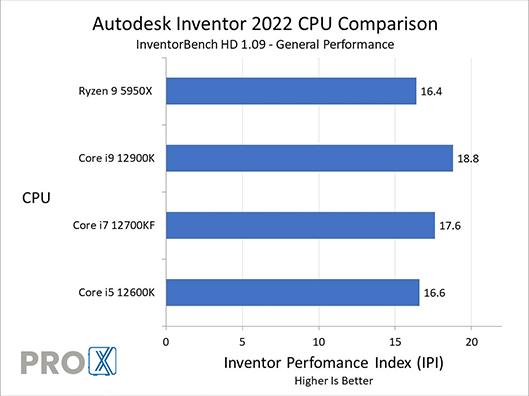
What is the best CPU for Autodesk Inventor?
In the case of Inventor, the majority of the software is only single threaded so it is only able to utilize a single core of the CPU. For this reason, our general recommendation when choosing a processor is to get the highest frequency. For current generation CPUs, that is Intel’s Core i9 or i7 K-series, both of which offer high clock speeds alongside a good number of cores. A lot of the cores in those processors are slower “efficiency” cores, though, which are most helpful for background tasks and heavily threaded rendering.
There are a handful of specific tasks in Inventor that are able to use more than one core (a list is available here), but CPUs like those recommended above have several cores and will generally do quite well there too. If you spend a lot of time with either rendering or FEA simulations, though, there can be reasons for going to an even higher core count. For those situations, we offer a workstation with AMD’s Ryzen 9 7950X with 16 full-speed cores.
Does having more CPU cores improve Inventor performance?
Designing and modeling in Inventor is not able to utilize more than a handful of cores. We have found that a CPU with the highest operating frequency will give you the best overall performance for general modeling tasks. Intel’s mainstream Core i7 and i9 processors currently offer very high single-core clock speed, without a high price tag, so that is our go-to recommendation. Rendering with the built-in engine, however, can see moderate to large performance gains with a higher core count CPU. For that reason we use Intel’s Core X processors with up to eighteen cores for our rendering-optimized Inventor workstation.
Do I need a Xeon CPU for Inventor?
In the past, Xeon CPUs were more robust than their Core-series counterparts. Today, however, there is very little functional difference between the two Intel product families for software like Inventor. Moreover, Xeons are almost always clocked at lower speeds than the Core series – which directly impacts performance. Xeon CPUs do support ECC memory, but while that is a nice feature it is certainly not essential.
Should I get an overclocked system for Inventor?
In general, we do not recommend overclocking for any professional workstation. Typically, the modest performance gains are not worth the downsides associated with overclocking which can include instability, shorter hardware lifespan, and potential data inaccuracies.
Our Inventor workstations are designed using only the most optimum hardware choices to give you the power you need to quickly and efficiently complete your work.