
Like most software developers, Maxon maintains a list of system requirements for Cinema 4D that can be used to help ensure the hardware in your system will work with their software. However, this “system requirements” list only covers the very basics of what hardware is needed to run the software, not what hardware will actually give the best performance. Because of how inconsistent those lists can be, we’ve taken the time to perform testing to determine what hardware runs Cinema 4D the best. Based on this testing, we have come up with our own list of recommended hardware for Cinema 4D.
What do I need for the best modeling and animation performance in Cinema 4D?
Modeling and animation in Cinema 4D are primarily single-threaded, so you want a CPU with the highest possible clock speed – but core count is not particularly important. A good video card is also needed, in order to smoothly display the 3D graphics you create.
Does rendering in Cinema 4D require different hardware?
The physical renderer built into Cinema 4D is a CPU-based rendering engine that benefits greatly from having a high number of cores. In fact, in our Cinema 4D CPU comparison we found that it scales almost perfectly with more cores. That means a high core count CPU, like AMD’s Threadripper PRO, is excellent for rendering in Cinema 4D. You also need enough memory, and both the complexity of a scene and its resolution will impact how much RAM is required. The video card does not play a significant role in rendering, though, unless you use a different rendering engine like Redshift.
What about combining design, animation, and rendering? Can one system do well with all of them?
As discussed above, for rendering you will want a high core count CPU. In the past, higher core counts usually meant lower clock speeds – but Intel and AMD both now offer “boost” technologies on most of their processors. Intel’s Turbo Boost and AMD’s Turbo Core adjust the clock speed depending on how many cores are active at a given time, so when only a few cores are working (like during modeling or animation within Cinema 4D) they can run at much higher clock speeds than when all cores are active (during rendering, for example). This results in the best performance for both situations from a single CPU. All of the processors in our Cinema 4D workstations support this technology, but if you need more assistance in selecting the right chip for a new workstation please reach out to our consultants.
How does Cinema 4D utilize the CPU?
The majority of design tasks in Cinema 4D (including creating, modifying, and animating 3D models) are only able to utilize a single CPU core which makes a high-frequency CPU – regardless of the core count – an ideal choice for these tasks. Because of this, our Design & Animation workstation focuses on high clock speeds with a moderate core count.
However, the rendering capabilities built into Cinema 4D – along with other CPU-based rendering engines like Arnold, Mental Ray, V-Ray Next CPU, and Keyshot – are very efficient at utilizing a high number of cores. In fact, most of these engines scale almost perfectly… which makes a CPU with twice the number of cores nearly twice as fast (assuming similar clock speeds). Dual processors can be effective for pure rendering, but they tend to have lower clock speeds and aren’t ideal for workstations where modeling is a core part of the workflow.
What are the best CPUs for Cinema 4D?
There are a lot of great processors for Cinema 4D, but here are some of our top recommendations:
Intel Core i7 13700K 16 Core – This is a good entry point for artists, with high clock speeds that put it near the top of the charts for single-core performance in Cinema 4D. If you do a significant amount of rendering, though, its smaller core count will be a limiting factor.
Intel Core i9 13900K 24 Core – This model has even more “efficient” cores, and slightly higher clock speeds, providing a small boost across the board and a little bit bigger bump for rendering in Cinema 4D. The newer i9 14900K is also great, but only a couple percent faster and unfortunately not available in our most compact workstations.
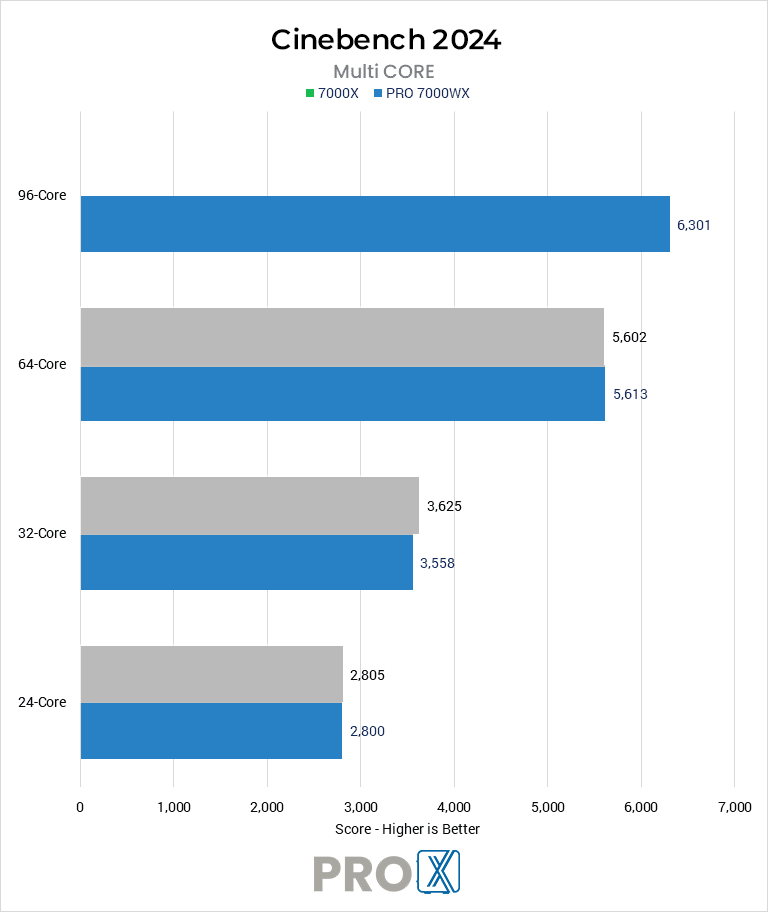
AMD Threadripper 7980X 64 Core – AMD’s Threadripper line packs huge core counts and high memory capacity while maintaining good per-core performance, making it a fantastic choice for workstations that are focused on rendering performance. The decent single-threaded speed means these chips also do well with modeling and animation, though they do fall behind the Core line in that area and cost a lot more as well. Technically the 96-core Threadripper PRO 7995WX is slightly faster, but the ~13% increase in rendering is not worth the many thousands of dollars higher price tag for most users.
Do I need a Xeon CPU for Cinema 4D?
In the past, Intel’s Xeon CPUs were more robust than their Core series counterparts. Today, however, there is very little functional difference between the two Intel product families for applications like Cinema 4D. In fact, the largest difference is simply the fact that the Xeon family allows for the use of dual CPU configurations… but at the cost of lower clock speeds and higher price tags. Because of this, we use Core i7 and i9 CPUs in most of our Cinema 4D workstations – and if you want a more rendering-focused workstation, AMD’s Threadripper series is both faster (per CPU) and more affordable than most Xeon configurations.
Whether you spend most of your time modeling, animating, simulating, or rendering in Cinema 4D, our recommended systems are designed specifically to meet your performance needs.