Nvidia didn't hold an event for this one. The RTX PRO 5500 Blackwell Workstation Edition just appeared on Nvidia's site, tagged "coming soon," specs marked preliminary, no price attached.
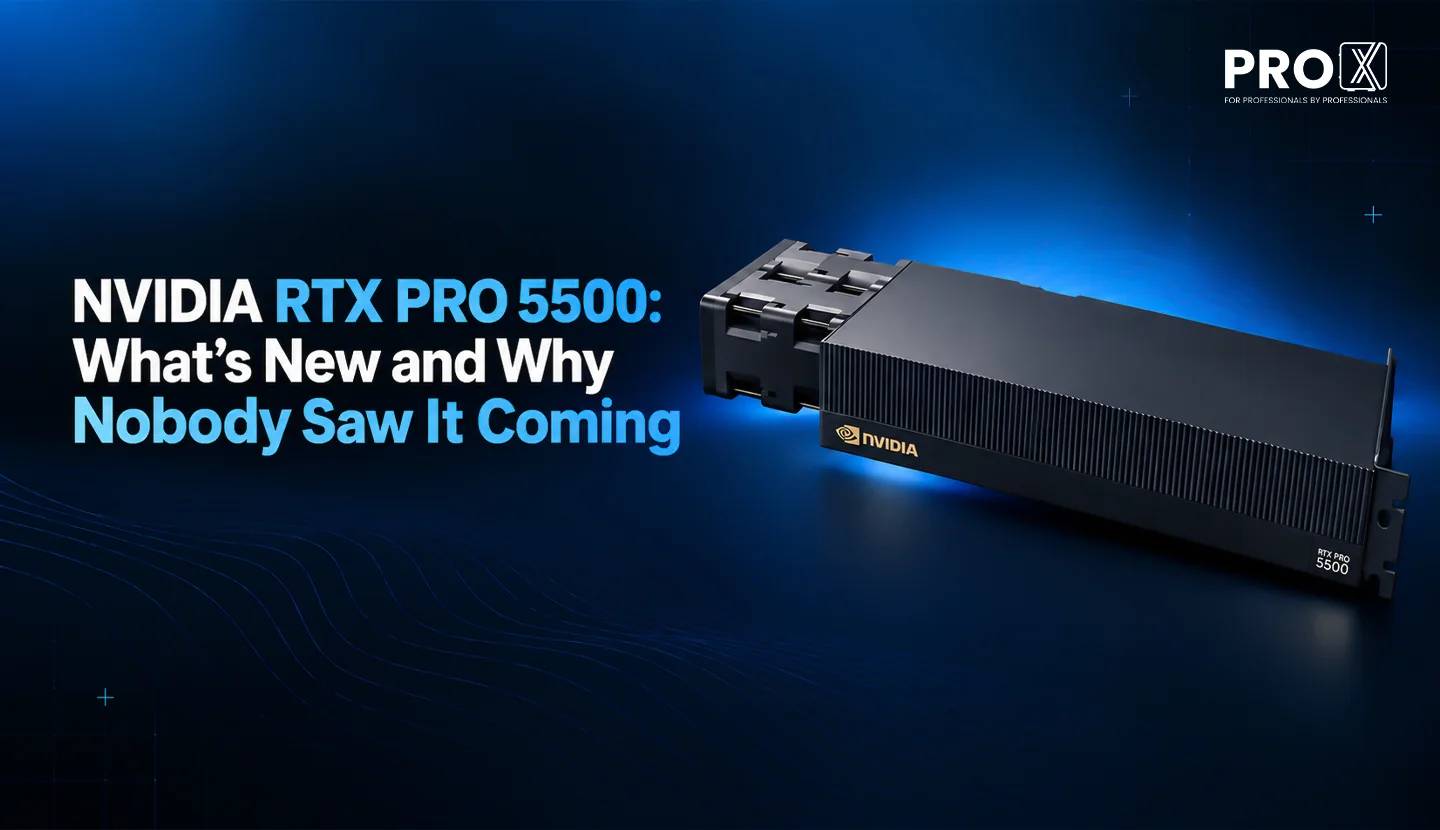
Nvidia didn't hold an event for this one. The RTX PRO 5500 Blackwell Workstation Edition just appeared on Nvidia's site, tagged "coming soon," specs marked preliminary, no price attached. That's a strange way to launch a card carrying 84GB of memory, more than most data center GPUs shipped five years ago.
If you are looking to upgrade or build new machine, that quiet rollout is worth paying attention to. It usually means the company is testing the market's reaction before committing to a number, and with this card, that looks like what's happening.
Strip away the marketing copy and the RTX PRO 5500 is a GB202 die, the same silicon inside the GeForce RTX 5090, carrying 21,760 CUDA cores (the parallel processing units that do the actual math behind rendering and AI compute). What's different is everything wrapped around that core: 84GB of GDDR7 memory (a faster class of graphics memory than the GDDR6 found on older cards) with error correction built in, a 600W power ceiling, and a design meant for rack-mounted deployment rather than a tower sitting under someone's desk.
That last part matters more than it sounds. Nvidia is pitching this as a card IT teams install in a server rack and share across a team using Multi-Instance GPU, or MIG, a feature that splits one physical GPU into isolated virtual ones. On the RTX PRO 5500, that means one 84GB instance, or two 42GB instances, each with its own memory and guaranteed performance so users aren't fighting over resources.
Here's the surprising part. To fit 84GB onto a die built for a 32GB gaming card, Nvidia had to sandwich memory chips on both sides of the circuit board, 14 up top, 14 underneath. It's a brute-force fix, Nvidia squeezing a workstation-class memory pool onto consumer-class silicon because demand for VRAM has outpaced the chips built to carry it.
Same CUDA core count, same die, wildly different job. The RTX 5090 ships with 32GB of GDDR7 and no error correction, runs on GeForce Game Ready drivers. It's built to push frames in a game engine, and it does that job well.
The RTX PRO 5500 runs on Nvidia's RTX Enterprise driver stack, certified against more than a hundred professional applications, which matters if your studio relies on software vendors who won't support you on consumer drivers. It also carries ECC memory, which catches and corrects memory errors before they corrupt a render or a training run, something a gaming card has no reason to include.
Think of it like buying a work van instead of a hatchback built on the same chassis. Same engine, same wheelbase, completely different tolerance for what happens if something goes wrong mid-job.
This is where the positioning gets genuinely odd. On paper, the RTX PRO 5500 sits between the two. In practice, it leans hard toward the flagship.
| Spec | RTX PRO 5000 | RTX PRO 5500 | RTX PRO 6000 |
| CUDA Cores | 14,080 | 21,760 | 24,064 |
| GPU Memory | 48GB or 72GB GDDR7 ECC | 84GB GDDR7 ECC | 96GB GDDR7 ECC |
| Memory Bandwidth | 1,344 GB/s | 1,398 GB/s | 1,792 GB/s |
| Max Power | 300W | 600W | 600W |
| MIG Instances | Yes | Up to 2 | Up to 4 |
| Launch Price | $4,199 (48GB) | Not yet announced | $8,565 |
Look at that power row. The RTX PRO 5500 draws the same power as the flagship, double what the mid-tier card needs, while offering fewer MIG partitions than the PRO 6000 despite carrying more memory than the PRO 5000. One hardware outlet put it bluntly after the spec sheet leaked: does an 84GB card pulling 600W really need a name that suggests it's a step below mid-range? The math says otherwise.
For a lot of studios and IT teams, the real comparison isn't the flashy new card. It's whatever they bought two years ago and are due to replace, and for workstation buyers, that's usually the RTX 5000 Ada Generation.
The jump is bigger than a normal generational bump. CUDA core count grows from 12,800 to 21,760, roughly 70% more. Memory bandwidth goes from 576 GB/s to 1,398 GB/s, close to two and a half times the throughput. Memory capacity nearly triples, from 32GB of GDDR6 to 84GB of GDDR7. The RTX 5000 Ada launched at around $4,000. Nobody knows yet what the RTX PRO 5500 will cost, but given everything below, don't expect it to land anywhere near that number.
Here's the part that explains the quiet, no-fanfare rollout. Memory chips are expensive right now, and GDDR7 in particular is tight across the whole industry. The RTX PRO 6000, which launched in March 2025 at an MSRP of $8,565, was listed on Nvidia's own marketplace at around $16,000 by September 2026, an 87% jump in about eighteen months. Reports also point to Nvidia holding back a planned RTX 50 SUPER refresh over pricing on 3GB GDDR7 modules, the same class of chip packed 28 times onto the RTX PRO 5500's board.
Put those two things together and the picture gets clearer. Nvidia has a flagship card whose price has nearly doubled because of memory costs, and a customer base that needs huge VRAM for agentic AI and LLM inference but can't all afford flagship pricing. The RTX PRO 5500 reads like an attempt to thread that gap: enough memory to matter, built for shared rack deployment so the cost spreads across a team, priced somewhere Nvidia hasn't committed to yet because the underlying memory market hasn't settled either. That's a supply chain story wearing a product launch as a disguise.
If you need a card installed right now, the RTX PRO 5500 isn't an option yet. It's not even priced. The RTX PRO 5000 and RTX PRO 6000 both ship today, and for most single-workstation setups, one of those two will get the job done.
The RTX PRO 5500 starts to make sense once you're planning past this quarter, not shopping for it. If your team runs agentic AI pipelines or large models across shared infrastructure and you were eyeing the RTX PRO 6000 mainly for its memory pool, this card is worth waiting on. Buying flagship hardware for headroom you won't use for a year is the same mistake as maxing out a budget on features nobody on the team asked for. Wait for the number, then decide.
For solo builders and smaller studios who don't need ECC memory or MIG partitioning, the RTX 5090 remains the cheapest way into this same silicon, GDDR7 and all. You give up professional driver certification and error correction, but at less than a quarter of what the RTX PRO 6000 costs, that's a trade a lot of buyers will happily make.
If you are interest in Computing solution or what to know more reach out to us
📞 011-40727769
Resources you may find helpful.

AI is revolutionizing the hardware industry by boosting design, manufacturing, maintenance, supply chains, personalization, autonomy, security, and energy efficiency.
Discover model-inferencing workstations: advanced AI systems revolutionizing industries from retail to smart cities and mastering complex tasks with cutting-edge technology.
Explore how hybrid systems revolutionize transportation, energy, manufacturing, and daily life by integrating diverse technologies for innovative solutions.

Delve into Edge AI's impact on latency, privacy, and autonomy. Uncover its applications in healthcare, manufacturing, retail, and security.