Workstations for Adobe Lightroom
Lightroom has a lot of time-consuming tasks but also requires a responsive system while correcting photos. Our workstations have been optimized to give you the best performance in both respects.
Lightroom System Requirements and Benchmarks
Like most software developers, Adobe maintains a list of system requirements for Lightroom CC that can be used to help ensure the hardware in your computer system will work with their software. However, most “system requirements” lists tend to cover only the very basics of what hardware is needed to run the software, not what hardware will actually give the best performance. In addition, sometimes these lists can be outdated, show old hardware revisions, or simply contain sub-optimal hardware.
Because of how inconsistent these lists can be, here at ProX PC we run and publish our own set of extensive hardware benchmarks to ensure that the systems we sell are perfectly tailored for Lightroom. Even better, you don’t have to take our word for what to buy, you can browse and examine all our testing in detail in our Lightroom hardware articles. Based on all our testing, we have our own list of recommended pc hardware for Lightroom.
The processor (or CPU) is one of the most important pieces of a Lightroom workstation. While GPU acceleration is gaining traction, right now your choice of CPU is usually going to make a much larger impact on overall system performance. However, be aware a CPU that is theoretically more powerful is not always better since there is a limit to the number of cores that Lightroom can effectively take advantage of. In many cases, spending more money can actually result in worse performance so it is more important to get the right CPU over a more expensive one.
What CPU is best for Lightroom ?
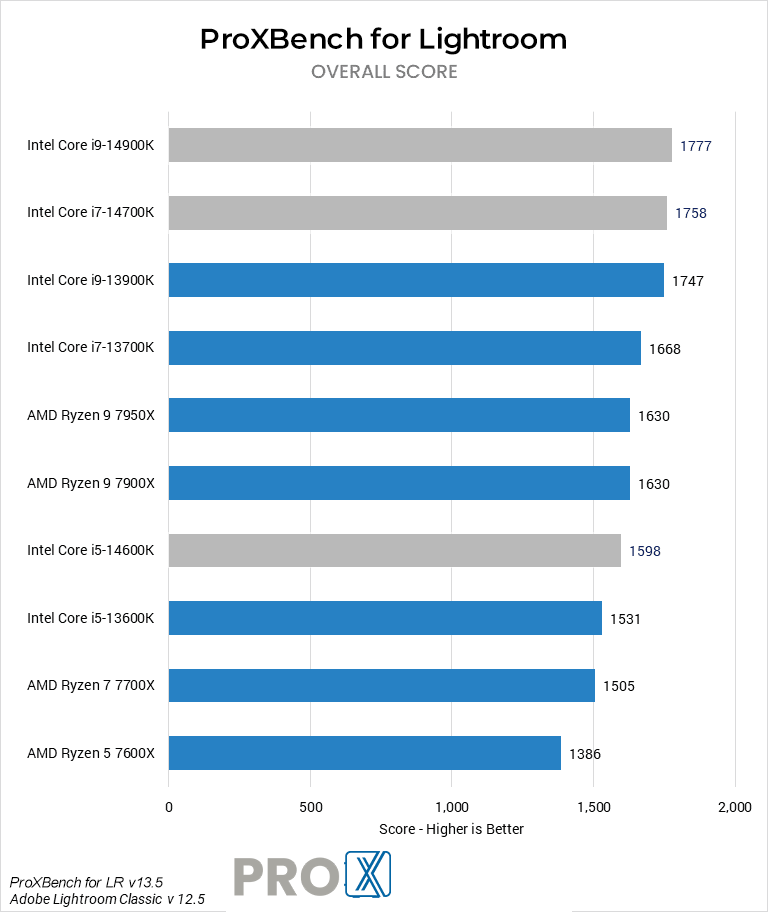
Currently, the best all-around CPU for most Lightroom tasks is Intel’s Core i9 14900K. For purely exporting, a higher core count processor like AMD’s Threadripper PRO can be a little faster – but for a much higher price and reduced performance in other parts of the workflow.
Do more cores make Lightroom faster?
With the launch of Lightroom , Adobe made great strides in being able to effectively utilize higher core count CPUs. However, having a high number of cores (more than ~8) typically only helps with a few tasks like exporting and generating previews. In most cases, the CPU frequency and underlying architecture makes a bigger impact than the raw number of cores.
Does Lightroom work better with Intel or AMD CPUs?
Because Lightroom is largely dependent on per-core performance, the best CPU for this application has gone back and forth between AMD and Intel frequently over the years. As shown in the chart to the right, Intel’s 12th Gen Core processors are currently in the lead – followed closely by AMD’s Ryzen 5000 Series. This is likely to change as each new generation of processors from Intel and AMD are released, though, so if you have any questions about the latest updates please contact our consulting team.
Adobe has been making increasing use of the GPU over the last several years, but currently it is not a major consideration for Lightroom. While a high-end GPU is not required to get the benefits of GPU acceleration in Lightroom, it may be a good idea to get a slightly faster GPU than you think you need to help future-proof your system as it is extremely likely that Adobe will increase GPU acceleration support in Lightroom in the future.
What GPU (video card) is best for Lightroom ?
Lightroom does not really utilize a modern video card for the majority of tasks, so we generally recommend a mid-range GPU to handle the needs of other related applications like Photoshop that do use the GPU more heavily. For most users, the NVIDIA GeForce RTX 4060 Ti is a solid choice. The growing exception to this is the recent addition of AI features by Adobe, which you can read more about on their website.
If you want to see how little performance difference there is in core Lightroom functionality between various GPUs, this article from a few years ago illustrates it well. We no longer include Lightroom in most of our GPU comparison articles for this reason.
How much VRAM (video card memory) does Lightroom need?
Since Lightroom does not heavily use the GPU, VRAM is typically not a concern. If you have a 4K display we recommend having at least 6GB of VRAM, although all the video cards we currently offer for Lightroom have at least 8GB of VRAM.
Does Lightroom need a professional Quadro card?
Lightroom can use a “professional” video card, like NVIDIA’s Quadro series, but for most users a GeForce card is the better option. Not only are GeForce cards much more affordable, they are able to match or beat the performance of the Quadro cards at a lower cost.
Does Lightroom run better with NVIDIA or AMD?
At the moment, NVIDIA has the lead over AMD in terms of performance. We have also found that NVIDIA cards tend to be slightly more reliable (both from a hardware and driver standpoint), which is why we typically use NVIDIA over AMD unless there is a clear benefit to using an AMD card.
How do I get 10-bit display support for Lightroom ?
10-bit displays are unfortunately not supported in Lightroom at the moment. If you want to add your voice to requesting this as a feature, you can vote for the feature request at Lightroom: Add 10-bit/channel color display support.
How much RAM does Lightroom need?
While the exact amount of RAM you need is going to depend on the size and number of images you will be working with, we generally recommend a minimum of 16GB for all our systems. For most users, 32GB of RAM should be enough for the majority of workflows. However, if you work with especially large images/catalogs or use the machine for other things like editing large images (750MB+) in Photoshop, you may need 64GB or more system RAM.
le the CPU may be what does all the processing, if your storage isn’t able to keep up it doesn’t matter how fast it is. What makes storage complicated is the fact that not only do you have to deal with the various types of drives available today, you also want to have them configured in a way that will maximize performance in Lightroom.
What type of storage drive should I use for Lightroom ?
There are three main types of drives you might use for a Lightroom workstation: SSD, NVMe, and the traditional platter drive. Of these three, traditional platter drives are the slowest but are extremely affordable and available in much larger capacities than SSD or NVMe drives. Due to this, they make excellent long-term storage drives, but depending on the size and resolution of your images, they may not ideal to work directly off of.
SATA SSDs are several times faster than a platter drive but are also more expensive. These drives are excellent for a wide range of tasks such as holding your OS and applications and storing photos and projects you are actively working on.
NVMe drives come in two flavors (M.2 and U.2), but either one will be significantly faster than even an SSD drive. They can be more expensive than a SATA SSD, but in return can be up to twelve times faster! In most cases, you will not see much of a performance increase with an NVMe drive since a modern standard SSD is already fast enough that it is rarely a performance bottleneck, but as the cost of these drives continue to fall, they can be used as an OS and application drive to make your system boot and launch programs a bit faster.
What storage configuration works best in Lightroom ?
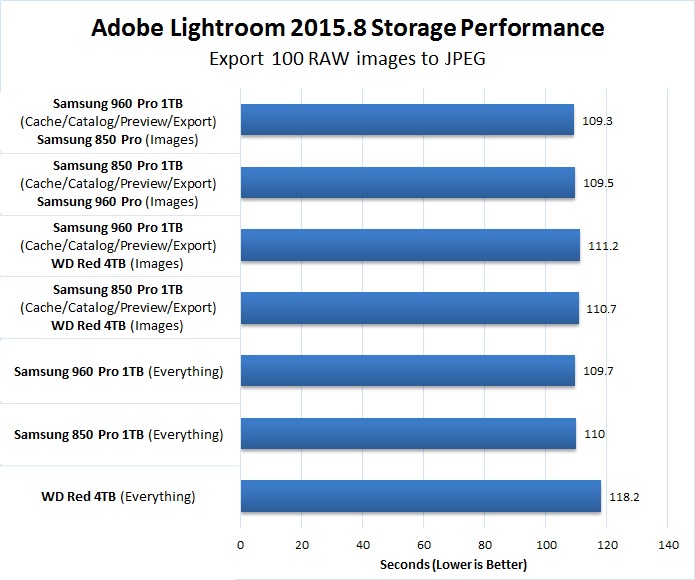
While you could get by with just a single drive, we recommend at least a two drive configuration depending on your budget and desired performance level:
- Primary Drive – OS/Software (SSD/NVMe) – Includes your operating system and the base Lightroom installation. An SSD is highly recommended as it will greatly improve how fast the OS and programs startup, but you can also upgrade to a faster NVMe drive for a small performance benefit.
Secondary Drive – Project Files (Platter/SSD/NVMe) – If possible, it is a good idea to keep your photos and catalogs on a secondary drive. For most users even a platter drive should be more than fast enough, although a SSD tends to be snappier and will often smooth out your workflow.
Can you work directly from an external drive in Lightroom ?
Technically, you could keep your photos on an external drive and edit directly from that drive. However, this is one of the most common causes of performance and stability issues we hear about from our customers. We highly recommend having a large enough internal drive so that you can copy all your files to a local drive before working on them. External drives are terrific for backup and archiving, but not ideal to work off of.
That analysis changes if you are looking at high-performance network-attached storage, rather than just a basic external hard drive. A serious software-defined storage system, especially one utilizing exclusively flash-based drives (rather than spinning disk drives), can absolutely be fast enough to edit directly from! We offer those types of solutions, both in the form of our ProX PC Storage line of servers as well as more bespoke options for high-end installations. This approach also facilitates easy sharing between various users in a studio and provides redundancy in case of a drive failure. It is important to make sure your network infrastructure is up to the challenge too!
Frequently Asked Questions
ProX PC's Maven workstations stand out for their exceptional performance and versatility. They feature high-end components, providing powerful computing capabilities for demanding tasks. The Maven workstations are designed with flexibility to scale, allowing for extensive customization to meet user-specific needs.
Absolutely! Over the years we have helped quite a few of our customer make the move from Mac to PC. In fact, it is a large enough number that we have a dedicated Need help moving from Mac to PC? page to answer some of the more common questions we receive.
Yes, we offer customizable solutions tailored to your specific requirements. Whether you need extra GPU power, additional RAM, or specialized storage solutions, we can build a workstation that meets your exact needs.
Yes, our workstations are designed with upgradeability in mind. You can easily upgrade components such as the GPU, RAM, and storage to keep up with evolving technology and increasing demands.
We provide comprehensive support, including technical assistance, troubleshooting, and warranty services. Our team is dedicated to ensuring your workstation operates at peak performance and addressing any issues that may arise.
You can contact us through our website's contact form, call our customer support-(011-40727769), or email us at sales@proxpc.com. Our team is ready to help you with any questions or to help you place an order.
ProX PC
Blogs
Read all Blogs

Select your Platform:
Why you should buy from ProX PC
Every ProX PC is unique
Our workstations are extensively customisable as per your requirements which makes your ProX PC Workstation PC unique.
 Stress Tested
Our Workstation PCs are stress tested with advance burn-in test techniques so as ensure that you get reliability and performance.
 Upto 3 Years of Onsite Warranty
Every Pro X PC comes with standard 3 Years RTB warranty or 3 Years of optional On-Site warranty at minimal cost that covers all your components and gives you peace of mind.
 80 Plus Quality Checks
To ensure that our Workstation PC exceeds the industry quality standards we have more than 80 quality check points in place so that you get best of the best.
 Performance Grade Cooling
Pro X PC Workstations are equipped with performance cooling solutions so that you could peak your components without stressing them out.
 Lifetime Tech Support
Even when your parts warranty expires, we continue to answer your questions and even fix your computer with no labor costs.