Contents
- Need for Automation in the Restaurant Industry
- Computer Vision and Al in Restaurants
- Use Cases of Computer Vision in Restaurants
- The Computer Vision Infrastructure
- Adopting Computer Vision: A Step-by-step Guide
- Conclusion - Visual Al Restaurant Technology
In the era of digital transformation, the restaurant industry is catching up, increasingly deploying AI technology to enhance efficiency, reduce costs, and create better customer experiences.
Computer vision, a subset of artificial intelligence (AI), enables machines to “see” and “understand” images and video in real-time. In the following, we discuss the vast potential of computer vision for restaurant innovation use cases and show how AI is shaping the future of the restaurant industry.
Need for Automation in the Restaurant Industry
In today’s fast-paced and highly competitive gastronomy landscape, restaurant businesses face a multitude of challenges. Those range from managing increasing operational costs and labor shortages to ensuring food safety and maintaining quality consistency. In parallel, customer expectations are increasing, driving the need for convenience, quick service, and sustainable practices.
To manage those challenges, restaurant owners aim to drive automation through the adoption of new technologies such as predictive or generative AI. Exemplary restaurant use cases include AI systems, chatbots, POS systems, smart ordering systems, kitchen automation, voice assistants, demand forecasting, sentiment analysis, ML data analytics, and more.
Automating operations not only streamlines workflows but also addresses these issues, helping restaurants stay profitable while consistently delivering high-quality service.
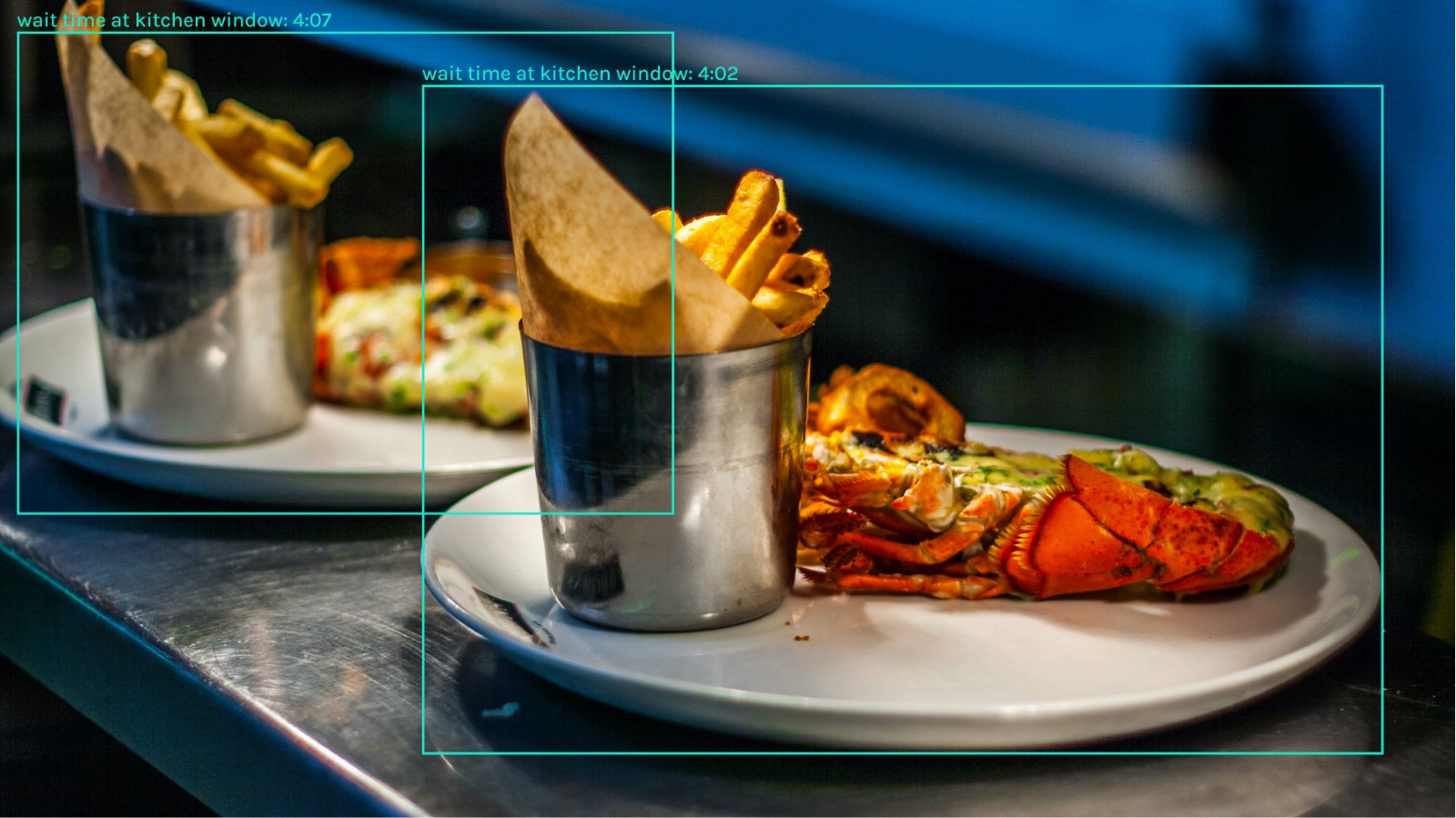
Restaurant Kitchens use computer vision for real-time object detection
Computer Vision and AI in Restaurants
AI vision powers automation with cameras that serve as the “eyes” to see and analyze situations with ML techniques. Real-time data is captured and analyzed by AI and deep learning algorithms. From tracking inventory to monitoring table occupancy, these systems provide 360-degree visibility into restaurant operations.
State-of-the-art computer vision applications can utilize common security cameras without additional sensors. This is important in the restaurant industry because businesses such as fast-food chains often operate in franchise models with diverse hardware set-ups.
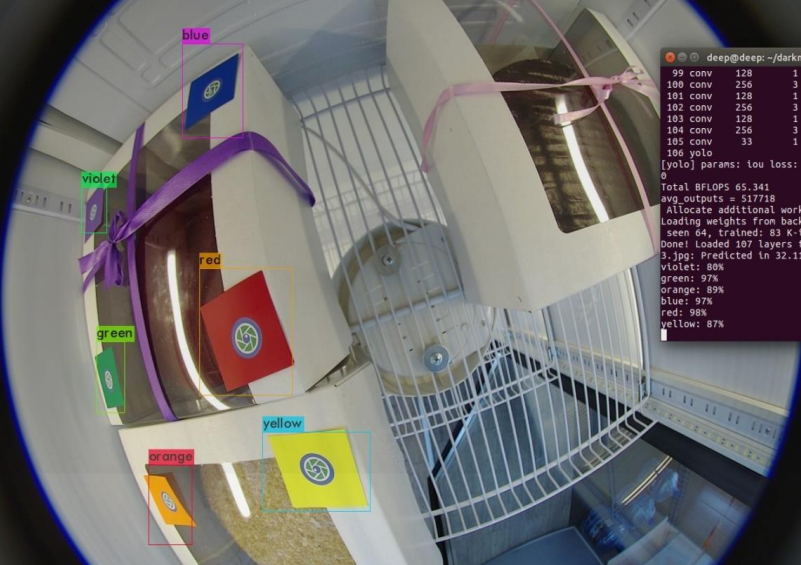
Application with an ML model based on YOLOv7 for smart refrigerators in restaurants
Use Cases of Computer Vision in Restaurants
Computer vision applications in restaurants are diverse and depend on the business model and strategy. Here are some of the most important visual AI restaurant use cases:
-
Quality Control: With computer vision, restaurants can automate food inspection for consistency and safety, reducing errors and waste. Standardized quality control is critical to avoid fines and food safety issues across large restaurant chains.
- Adherence to SOPs: Visual Al is used to automatically monitor kitchen hygiene and adherence to SOPs, for example, to ensure that employees are wearing gloves and hair restraints at all times. Such use cases are important for ghost kitchens or fast food restaurants, where the brand owners have limited possibilities to ensure adherence to guidelines.
- Table Management: Intelligent algorithms can monitor table occupancy to manage seating arrangements efficiently, increasing turnover rates. Optimizing table occupation is highly important for cafes and bistros. Similarly, cameras can be used to analyze the utilization of parking lots and drive-throughs.
- Inventory Management: Applications for inventory tracking can provide predictions for restocking requirements. They use object detection and counting, multi-barcode detection, and label reading. Buffet restaurants can also use Al vision to optimize the refilling process.
- Customer Engagement: Computer vision can recognize customer behavior patterns and preferences. This is used to drive customer engagement and improve the customer experience, for example, through queue detection to reduce waiting times. This is important for conventional restaurants but also food trucks, cafes, or bistros.
- Staff Efficiency: Workflow analysis helps streamline staff movement and increase operational efficiency at the point of sales. The visual algorithms make it possible to make better hiring decisions based on objective data points.
Reach out and get in touch with us to learn more about use cases for your restaurants.
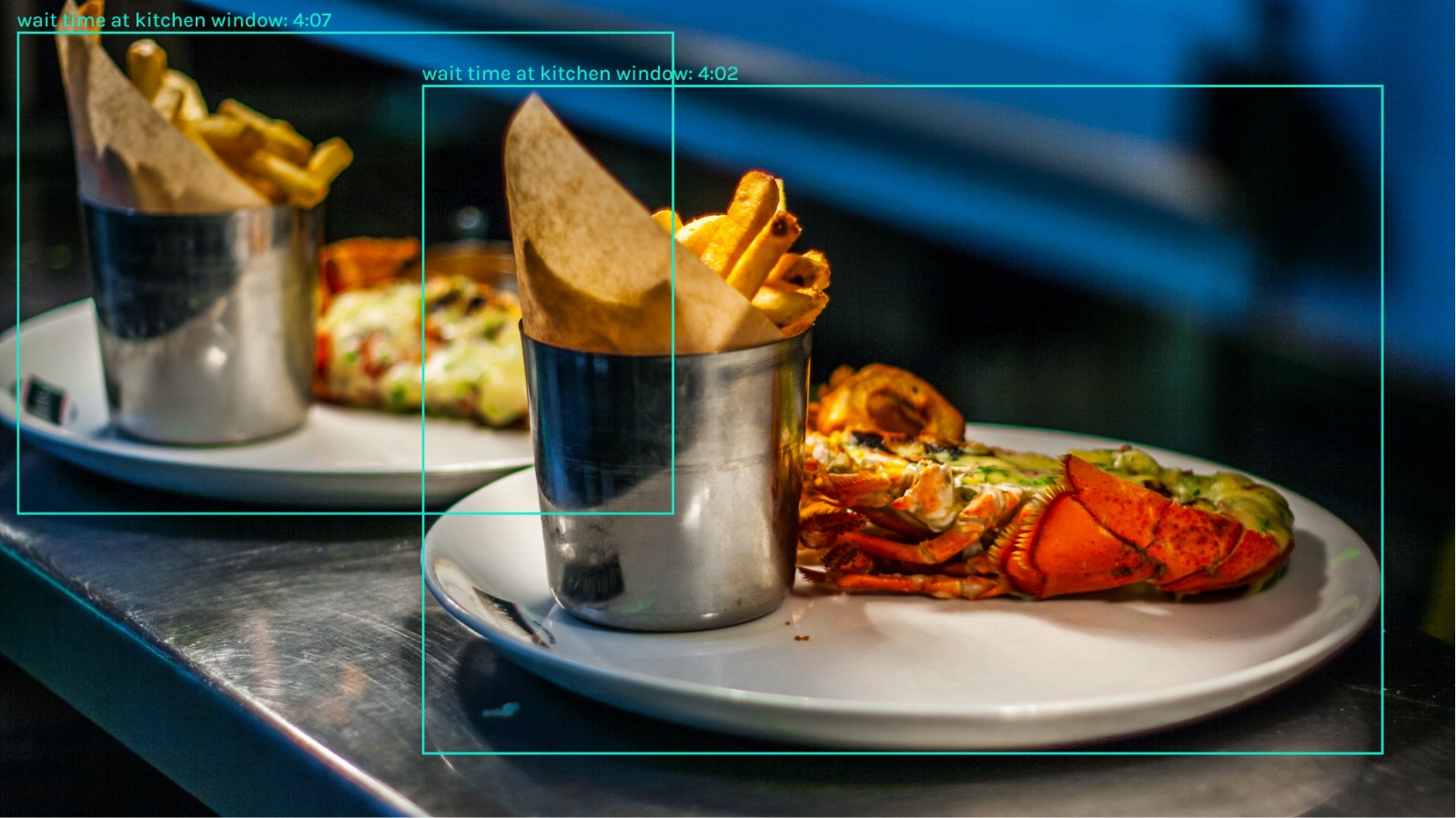
Object and Person Detection in Restaurants with YOLOv8
The Computer Vision Infrastructure
Software infrastructure for computer vision systems refers to a combination of various technologies, platforms, and tools necessary to develop, deploy, and manage computer vision applications. Such an AI vision infrastructure typically includes a large number of ML libraries and frameworks for image and video processing, such as OpenCV, TensorFlow, or PyTorch.
The AI vision infrastructure provides the AI software systems to scale, maintain, and troubleshoot computer vision projects effectively. Since most companies will need several applications, the AI infrastructure must be robust and flexible enough to operate all applications in one place.
Because computer vision involves large video data and massive computing workloads, such AI vision systems have to run “at the edge”. Such Edge AI architectures orchestrate large-scale deployments to distributed edge devices (servers) that are connected to physical cameras across the restaurants.
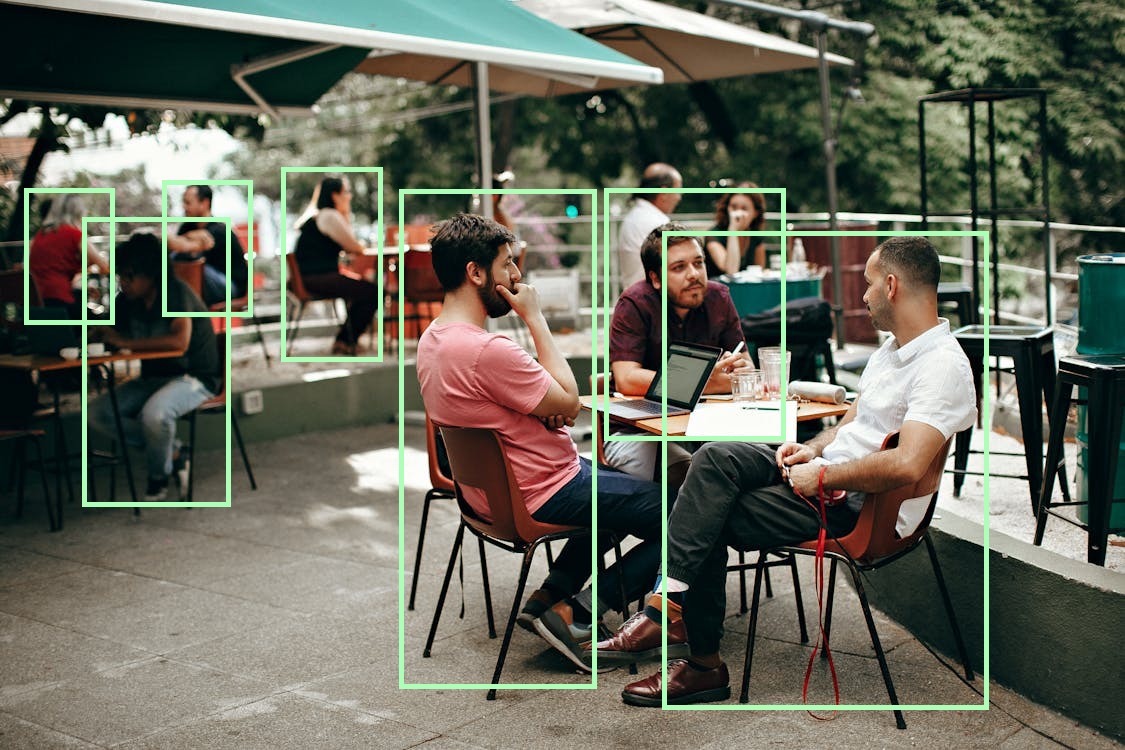
Person detection for occupancy detection in restaurants
ProX PC – The End-To-End AI Infrastructure
The ProX PC Computer Vision Platform is the only full end-to-end solution for businesses to build and scale their real-world computer vision applications. It provides an intuitive interface, seamless hardware and software integrations, and powerful privacy and security tools.
ProX PC is suitable for building custom computer vision solutions and managing, scaling, and optimizing multiple applications in one place. This makes it an ideal choice for restaurant owners looking to automate operations with computer vision without exposing their data and applications.
Reach out and get a demo for your company, and start a proof of concept with a first pilot application.
Make vs. Buy Ready-made Computer Vision Solutions
When it comes to implementing advanced technologies like computer vision, businesses often face the “make or buy” dilemma. While buying a ready-made solution can offer “canned” tools, more and more restaurant businesses have decided to build up their own AI vision systems.
One key reason behind this choice is data control and privacy. Businesses generate vast amounts of valuable data that can provide competitive advantages when analyzed and utilized effectively. By building their own systems, restaurant operators retain full ownership and control over their data, ensuring it stays safe and can be used to its maximum potential.
Moreover, custom-built computer vision systems can be tailored to the specific needs and processes of the business. Often, an off-the-shelf solution does not provide the required level of integration. Custom systems allow for greater flexibility to make adjustments or additions as the business evolves.
At ProX PC, we enable businesses to train their teams and partners to implement computer vision projects rapidly with automated products. Meanwhile, we provide all the support and professional services needed. Get in touch to learn more.
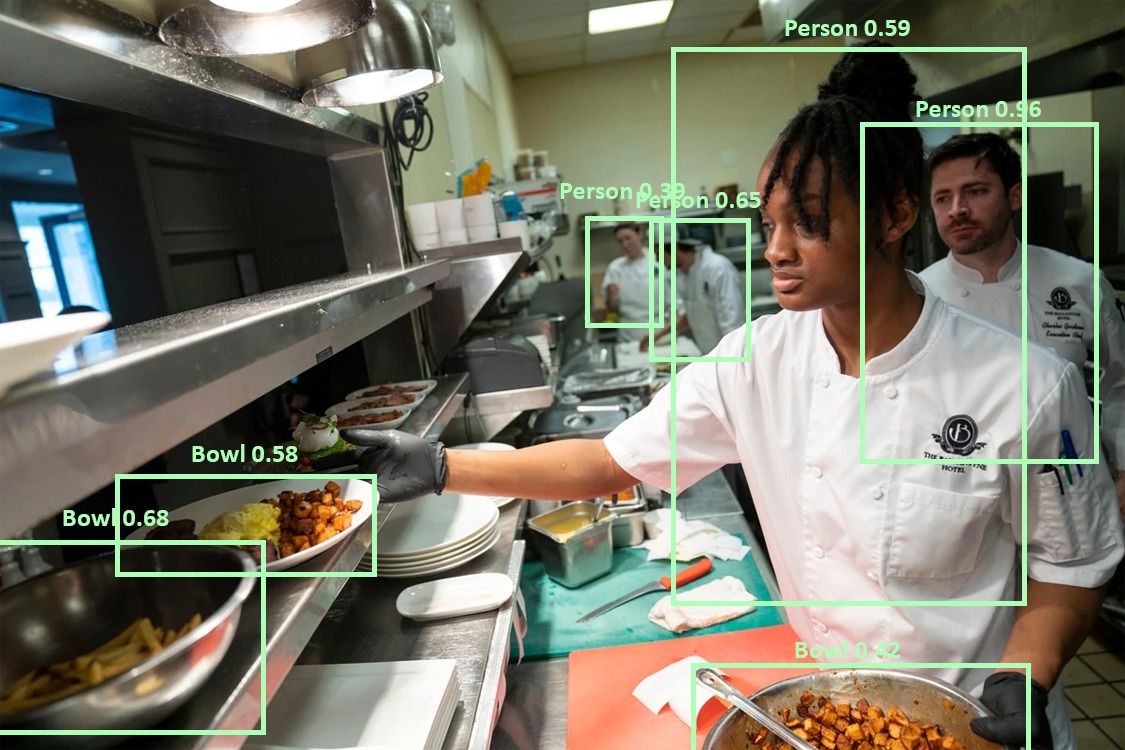
Deep Learning in Restaurant Applications
Adopting Computer Vision: A Step-by-step Guide
Conclusion – Visual AI Restaurant Technology
As restaurants evolve, computer vision technology will play an increasingly central role in their ability to automate operations. Especially large restaurant chains can leverage AI technology for AI vision in restaurants to gather data, automate processes, and reduce costs.
The ProX PC Computer Vision Platform provides a powerful solution for restaurants seeking to leverage this technology, providing a comprehensive infrastructure suitable for all computer vision applications needed today and in the future.
Related Products
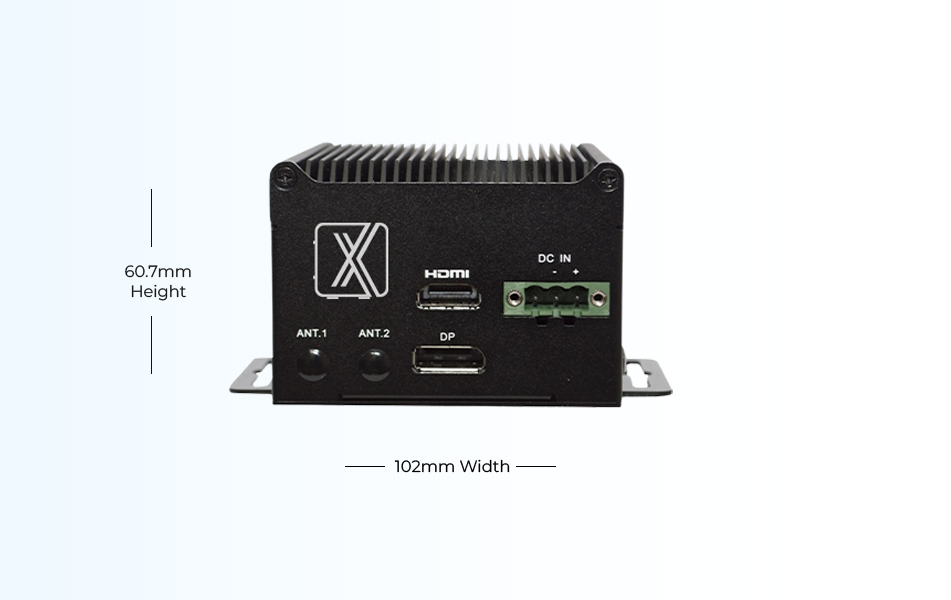
ProX MicroEdge Orin Nano
- Compact AI accelerator with 6-core Arm® Cortex® CPU and 1024/512-core NVIDIA Ampere GPU with Tensor Cores
- 8GB/4GB of high-speed LPDDR5 memory and NVMe SSD
- Dual GbE ports, Wi-Fi options, and 4G/5G support
- Versatile I/O and robust features
- Ideal for data-intensive tasks and AI innovation
Learn more
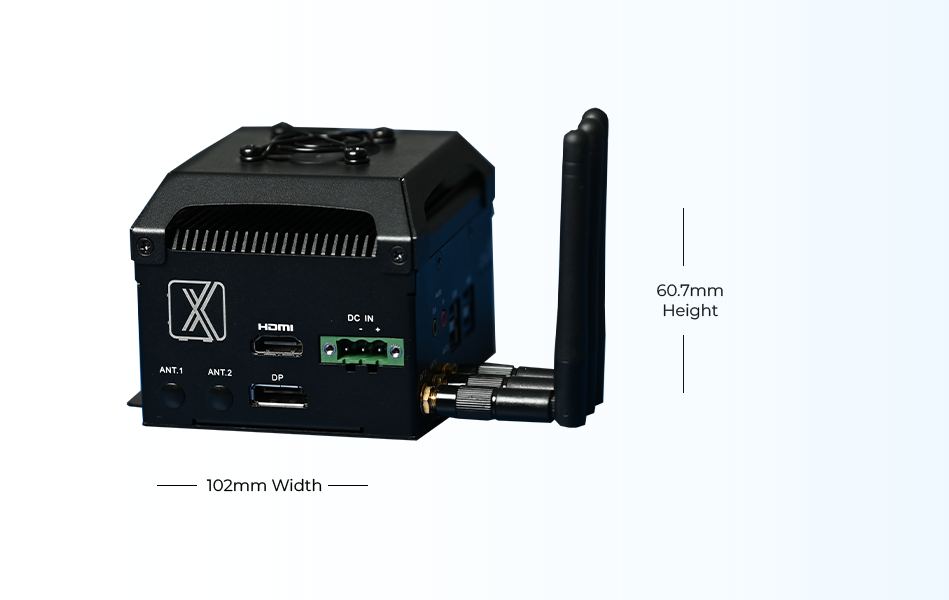
ProX MicroEdge Orin NX
- Compact powerhouse that combines an 8/6-core Arm® Cortex® CPU, a 1024-core NVIDIA Ampere GPU with 32 Tensor Cores, and lightning-fast 128-bit LPDDR5 memory.
- Store and retrieve data seamlessly with an NVMe SSD and Micro SD slot.
- Stay connected with dual GbE ports, Wi-Fi options, and 4G/5G support.
- Versatile I/O options, including USB 3.1 and HDMI, make interfacing a breeze.
- Unlock the future of AI innovation with Jetson Orin NX.
Learn more